
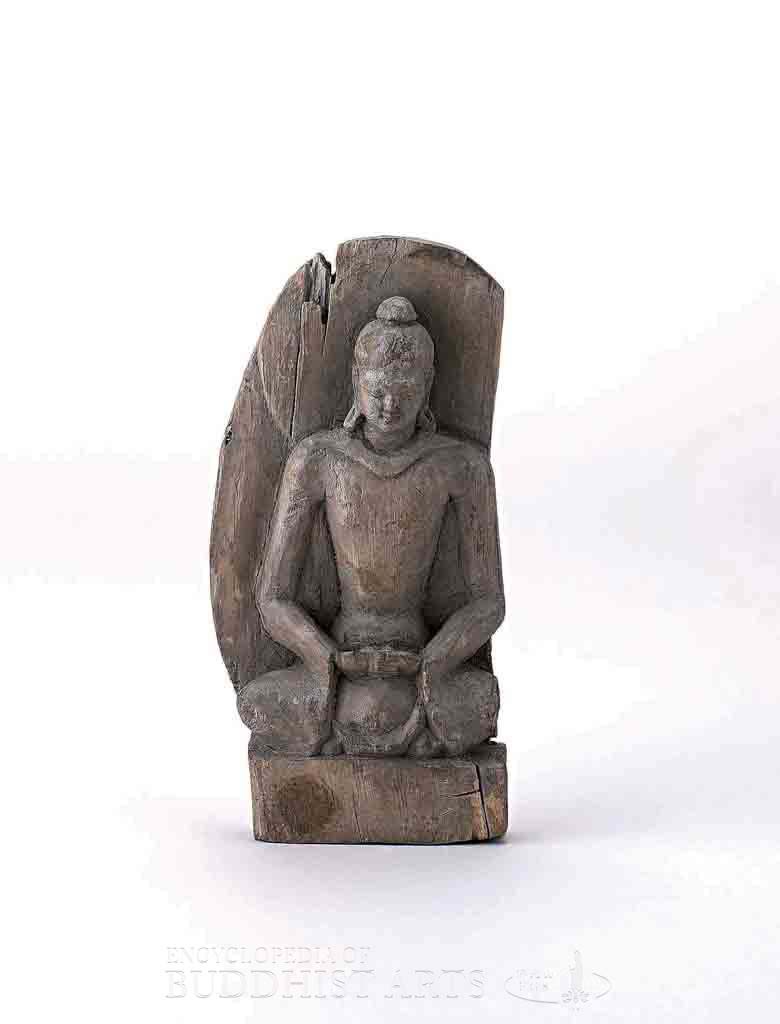
Horo Shan: Seated Buddha
Wood
Horo Shan: Seated Buddha
CHINA, Xinjiang, Bayingolin
The statue was discovered in 1917 at the temple site of Horo Shan in Bayingol and taken to England by the archaeologist, Aurel Stein.
The Buddha is seated in meditation posture on a rectangular base. The figure curves slightly to one side and the long arms are out of proportion compared with the short legs. A plain nimbus is just visible as a raised area behind the head, and a part of the mandorla is missing. Traces of pigment indicate that the piece was once painted.
For more details, go to the Encyclopedia of Buddhist Arts: Sculpture G-M, page 440.
Cite this article:
Hsingyun, et al. "Horo Shan: Seated Buddha." Encyclopedia of Buddhist Arts: Sculpture G-M, vol. 11, 2016, pp. 440.
Hsingyun, Youheng, Yann Lovelock, Yuan Chou, Susan Huntington, Gary Edson, and Robert Neather. 2016. "Horo Shan: Seated Buddha" In Encyclopedia of Buddhist Arts: Sculpture G-M, 11:440.
Hsingyun, Youheng, Lovelock, Y., Chou, Y., Huntington, S., Edson, G., & Neather, R.. (2016). Horo Shan: Seated Buddha. In Encyclopedia of Buddhist Arts: Sculpture G-M (Vol. 11, pp. 440).
@misc{Hsingyun2016,
author = Hsingyun and Youheng and Lovelock, Yann and Chou, Yuan and Huntington, Susan and Edson, Gary and Neather, Robert,
booktitle = {Encyclopedia of Buddhist Arts: Sculpture G-M},
pages = 440,
title = {{Horo Shan: Seated Buddha}},
volume = 11,
year = {2016}}
author = Hsingyun and Youheng and Lovelock, Yann and Chou, Yuan and Huntington, Susan and Edson, Gary and Neather, Robert,
booktitle = {Encyclopedia of Buddhist Arts: Sculpture G-M},
pages = 440,
title = {{Horo Shan: Seated Buddha}},
volume = 11,
year = {2016}}