
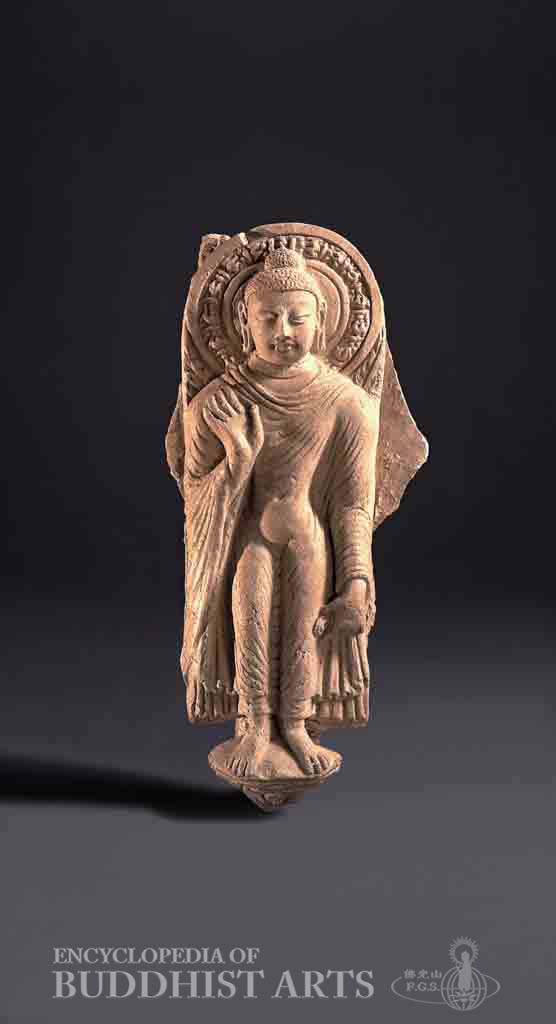
Kalasai: Standing Buddha
Stucco
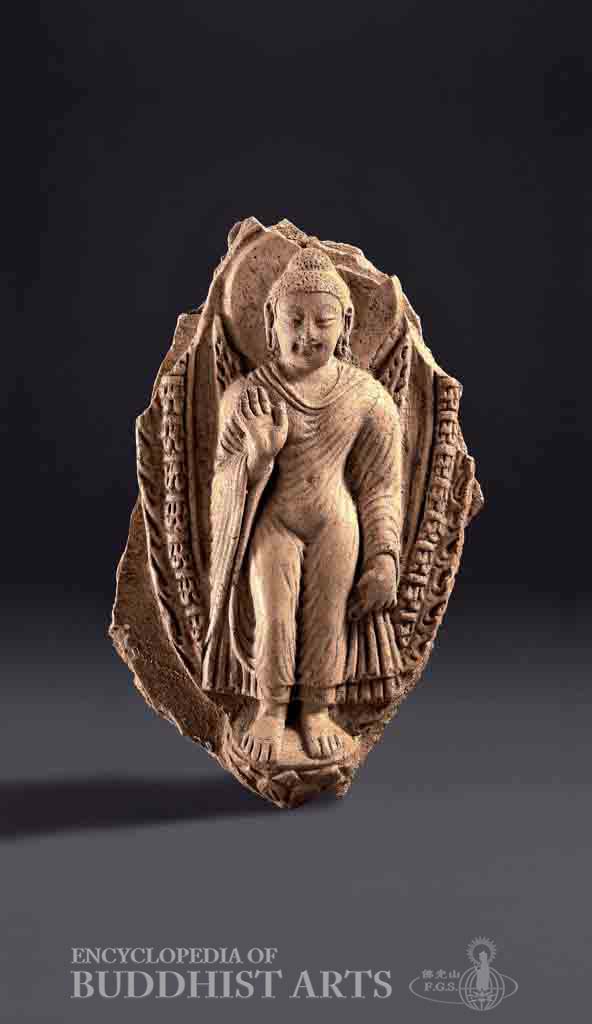
Kalasai: Standing Buddha
Kalasai: Standing Buddhas
CHINA, Xinjiang, Hotan
Both figures are standing in the same posture, although one is better preserved than the other. The right hands are in abhaya (fearlessness) mudra and the other hands are lowered to grasp the monastic robes. The thin robes that reveal the shape of the bodies are reminiscent of the Indian Mathura style. Both right feet are slightly advanced on the lotus pedestal. One figure has a plain nimbus and is enclosed in a decorative mandorla, while the other has a decorative nimbus and a mandorla too broken to reveal any detail. The form of the statues suggests they were once part of a larger altarpiece.
For more details, go to the Encyclopedia of Buddhist Arts: Sculpture G-M, page 518.
Cite this article:
Hsingyun, et al. "Kalasai: Standing Buddhas." Encyclopedia of Buddhist Arts: Sculpture G-M, vol. 11, 2016, pp. 518.
Hsingyun, Youheng, Yann Lovelock, Yuan Chou, Susan Huntington, Gary Edson, and Robert Neather. 2016. "Kalasai: Standing Buddhas" In Encyclopedia of Buddhist Arts: Sculpture G-M, 11:518.
Hsingyun, Youheng, Lovelock, Y., Chou, Y., Huntington, S., Edson, G., & Neather, R.. (2016). Kalasai: Standing Buddhas. In Encyclopedia of Buddhist Arts: Sculpture G-M (Vol. 11, pp. 518).
@misc{Hsingyun2016,
author = Hsingyun and Youheng and Lovelock, Yann and Chou, Yuan and Huntington, Susan and Edson, Gary and Neather, Robert,
booktitle = {Encyclopedia of Buddhist Arts: Sculpture G-M},
pages = 518,
title = {{Kalasai: Standing Buddhas}},
volume = 11,
year = {2016}}
author = Hsingyun and Youheng and Lovelock, Yann and Chou, Yuan and Huntington, Susan and Edson, Gary and Neather, Robert,
booktitle = {Encyclopedia of Buddhist Arts: Sculpture G-M},
pages = 518,
title = {{Kalasai: Standing Buddhas}},
volume = 11,
year = {2016}}