
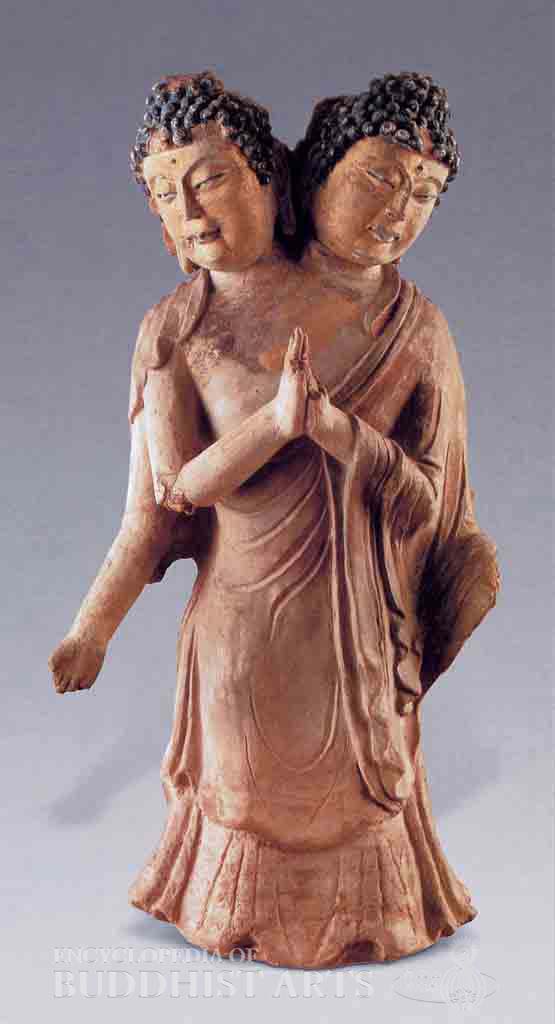
Khara Khoto: Two-Headed Buddha
Clay
Khara Khoto: Two-Headed Buddha
CHINA, Inner Mongolia, Alxa; Western Xia period
The Indian legend of the miraculous two-headed Buddha image is recorded in the Great Tang Records on the Western Regions. It relates that there were two poor men who made a vow to sponsor a painting of the Buddha but their savings were not enough to pay the artist for two paintings. So the artist drew a two-headed Buddha for them, and while they were unsure about the artist’s decision, the Buddha in the painting multiplied and filled the room with light.
This is a sculptural representation of the two-headed Buddha painting. In this representation, the separated heads look to the left and right. The body is four armed, with one pair of hands held before the heart in anjali (reverence) mudra. The two others were held out to the side but have been damaged, while the feet below the monastic robe are missing.
For more details, go to the Encyclopedia of Buddhist Arts: Sculpture G-M, page 531.
Cite this article:
author = Hsingyun and Youheng and Lovelock, Yann and Chou, Yuan and Huntington, Susan and Edson, Gary and Neather, Robert,
booktitle = {Encyclopedia of Buddhist Arts: Sculpture G-M},
pages = 531,
title = {{Khara Khoto: Two-Headed Buddha}},
volume = 11,
year = {2016}}