
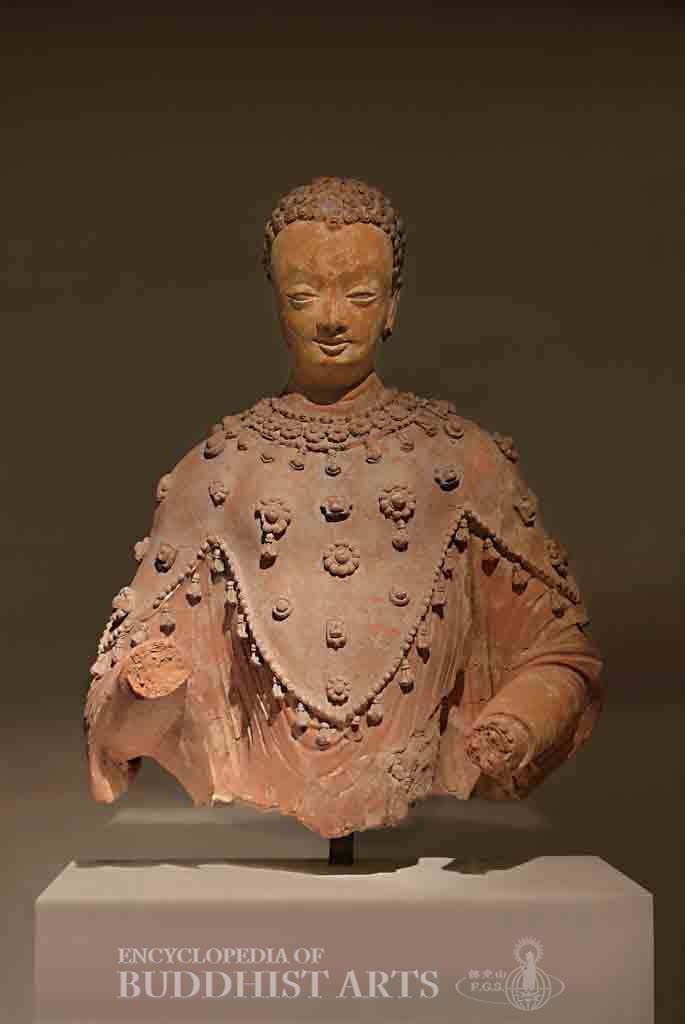
Fondukistan: Fragment of a Buddha
Plaster
Fondukistan: Fragment of a Buddha
AFGHANISTAN, Parwan, Fondukistan
This fragment, excavated from the temple ruins of Fondukistan, was heavily influenced by Persian art and is unique to the area of Bamiyan. Representations of the Buddha were fused with that of the cakravartin, a wheel-turning monarch, during that time. This Buddha has a high forehead, above which the ringlets of the hair have been individually molded. The face tapers to a very short chin. The eyelids are heavy and the eyes narrow; the nose is prominent, the lips slightly opened. Blue pigment is still visible on the hair and the rest of the body was probably painted once. A beaded bracelet is just visible on the damaged left wrist. The right arm is slightly raised and can be assumed to have formed the abhaya (fearlessness) mudra. A three-pointed mantle, studded with flower ornaments and tasseled at the edge, is worn over a robe. Around the neck is a beaded necklace ornamented with flower medallions and pendants.
For more details, go to the Encyclopedia of Buddhist Arts: Sculpture A-F, page 345.
Cite this article:
author = Hsingyun and Youheng and Lovelock, Yann and Chou, Yuan and Huntington, Susan and Edson, Gary and Neather, Robert,
booktitle = {Encyclopedia of Buddhist Arts: Sculpture A-F},
pages = 345,
title = {{Fondukistan: Fragment of a Buddha}},
volume = 10,
year = {2016}}