
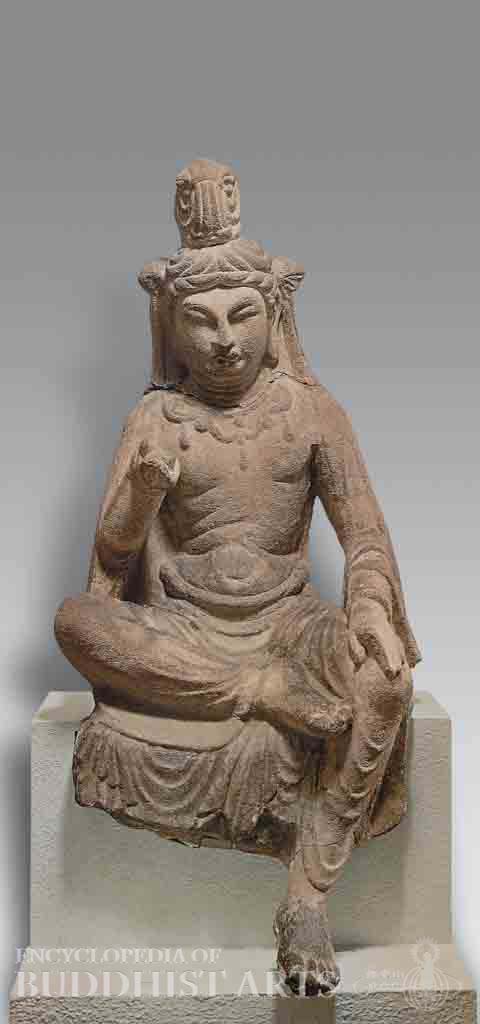
Seated Bodhisattva
Sandstone
Seated Bodhisattva
CHINA; Tang dynasty
The figure is said to have originated from the north wall of Tianlongshan Cave 17 in Taiyuan, Shanxi. However, testing has showed that the surface of the statue has been retouched and so its authenticity remains unverified.
The Bodhisattva is seated in the relaxation posture with the left hand resting on the knee where the leg overhangs the seat. The body is slightly inclined to one side, where the other hand is raised. The figure’s hair is braided about the forehead and coiled into a high topknot. The jewelry is confined to an elaborate neckpiece from which pendants hang. The folds of the loose skirt define the shape of the legs beneath.
For more details, go to the Encyclopedia of Buddhist Arts: Sculpture N-Sr, page 986.
Cite this article:
Hsingyun, et al. "Seated Bodhisattva." Encyclopedia of Buddhist Arts: Sculpture N-Sr, vol. 12, 2016, pp. 986.
Hsingyun, Youheng, Yann Lovelock, Yuan Chou, Susan Huntington, Gary Edson, and Robert Neather. 2016. "Seated Bodhisattva" In Encyclopedia of Buddhist Arts: Sculpture N-Sr, 12:986.
Hsingyun, Youheng, Lovelock, Y., Chou, Y., Huntington, S., Edson, G., & Neather, R.. (2016). Seated Bodhisattva. In Encyclopedia of Buddhist Arts: Sculpture N-Sr (Vol. 12, pp. 986).
@misc{Hsingyun2016,
author = Hsingyun and Youheng and Lovelock, Yann and Chou, Yuan and Huntington, Susan and Edson, Gary and Neather, Robert,
booktitle = {Encyclopedia of Buddhist Arts: Sculpture N-Sr},
pages = 986,
title = {{Seated Bodhisattva}},
volume = 12,
year = {2016}}
author = Hsingyun and Youheng and Lovelock, Yann and Chou, Yuan and Huntington, Susan and Edson, Gary and Neather, Robert,
booktitle = {Encyclopedia of Buddhist Arts: Sculpture N-Sr},
pages = 986,
title = {{Seated Bodhisattva}},
volume = 12,
year = {2016}}