
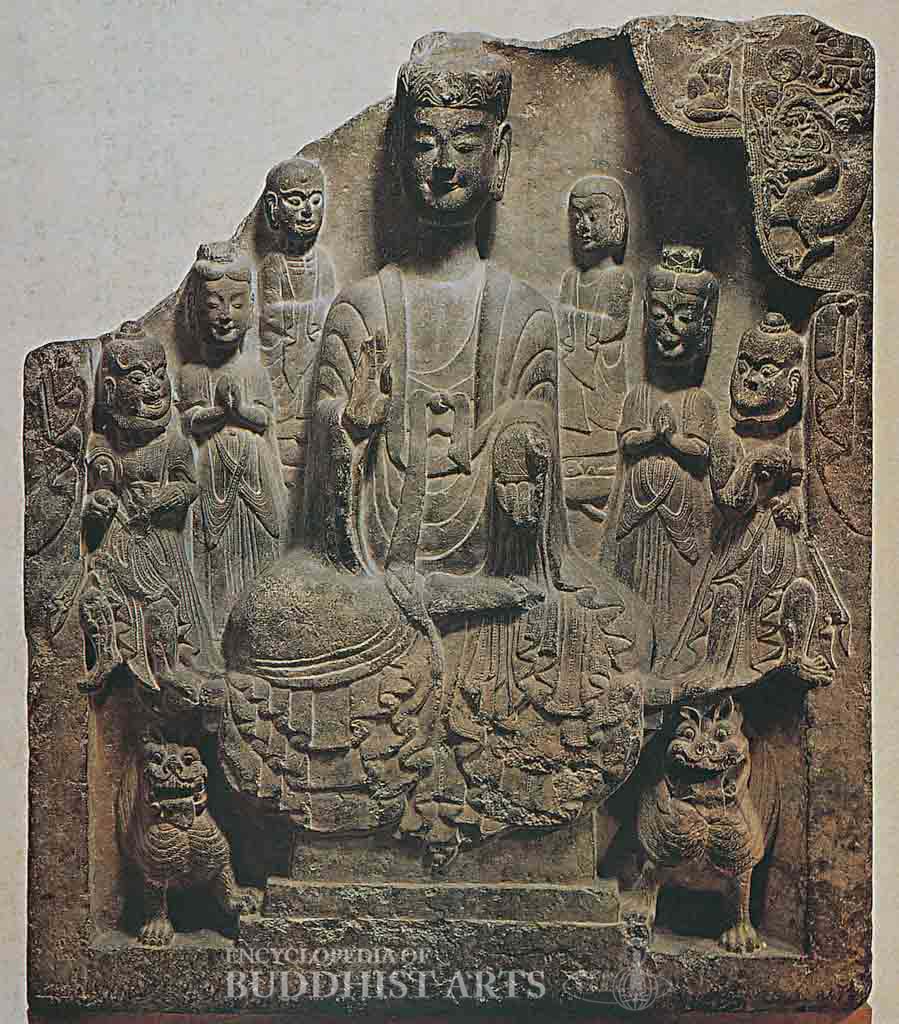
Sakyamuni Buddha and Attendants
Limestone
Sakyamuni Buddha and Attendants
CHINA; Eastern Wei dynasty
Sakyamuni Buddha, located in the center of the composition, sits in half lotus position with hands probably in the abhaya (fearlessness) and varada (wish-granting) mudras. The Buddha’s garment cascades down the throne in stylized rippling folds which then merge with the background on which the surrounding figures stand. The disciples Mahakasyapa and Ananda stand on either side with their hands hidden in their robes. Next to the disciples are Bodhisattvas with palms joined in reverence as well as warriors posing in the warrior stance. What remains of the border shows reliefs of a dragon, a canopy, and a kneeling figure. Two winged lions stand guard with one paw mounted on the throne. A worn inscription at the back states that the sculpture was dedicated by 100 villagers and dates the artwork to 536.
For more details, go to the Encyclopedia of Buddhist Arts: Sculpture N-Sr, page 933.
Cite this article:
author = Hsingyun and Youheng and Lovelock, Yann and Chou, Yuan and Huntington, Susan and Edson, Gary and Neather, Robert,
booktitle = {Encyclopedia of Buddhist Arts: Sculpture N-Sr},
pages = 933,
title = {{Sakyamuni Buddha and Attendants}},
volume = 12,
year = {2016}}