
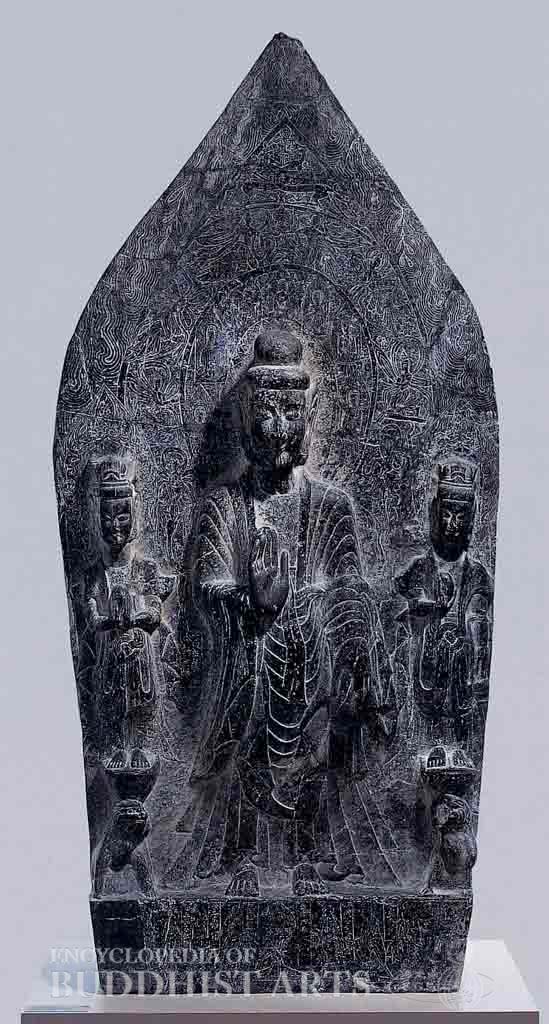
Buddha Triad
Stone
Buddha Triad
CHINA; Northern Wei dynasty
The Buddha has a prominent usnisa and a long narrow face. He wears a robe that covers both shoulders and is opened at the front. The Buddha’s hands form the abhaya (fearlessness) and varada (wish-granting) mudras. The attendant Bodhisattvas stand on lotus pedestals supported by lions. They wear headdresses and robes that cross through a ring at the abdomen. The Bodhisattva on the left holds a lotus with both hands, while the one on the right holds a lotus petal in one hand and a vase in the other.
The Buddha’s oval nimbus is in two layers, with seated Buddhas in the inner layer and apsaras in the outer layer. The apex of the mandorla has a pair of intertwining dragons, while the rest of the mandorla is adorned with flame motifs. An inscription on the statue dates it to 520.
For more details, go to the Encyclopedia of Buddhist Arts: Sculpture A-F, page 210.
Cite this article:
author = Hsingyun and Youheng and Lovelock, Yann and Chou, Yuan and Huntington, Susan and Edson, Gary and Neather, Robert,
booktitle = {Encyclopedia of Buddhist Arts: Sculpture A-F},
pages = 210,
title = {{Buddha Triad}},
volume = 10,
year = {2016}}