
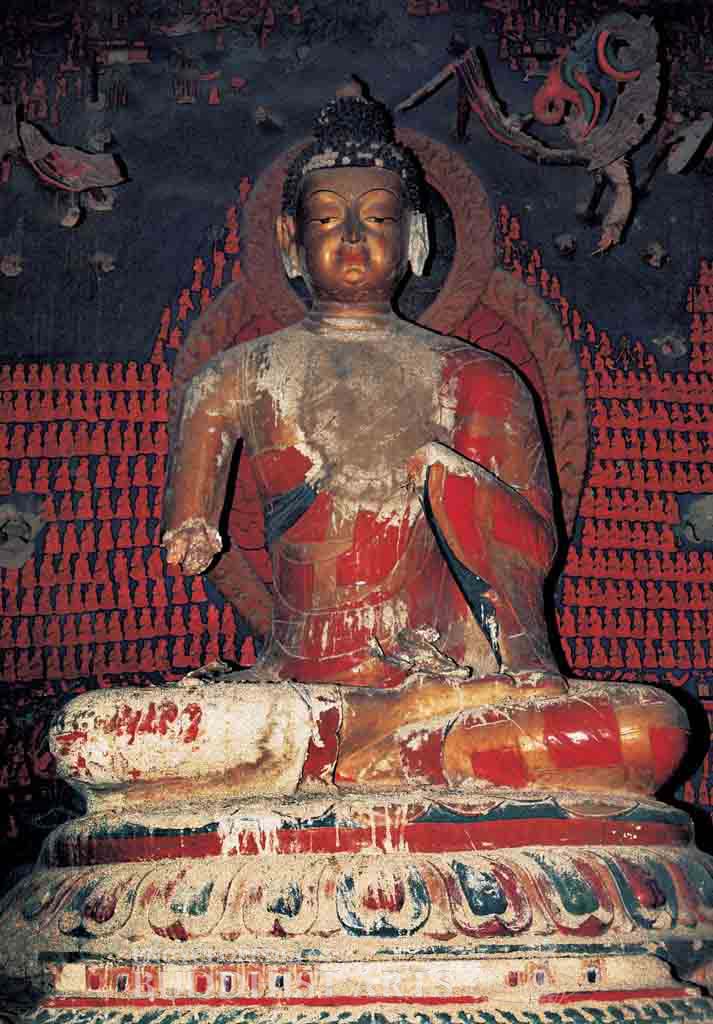
Guge White Temple: Sakyamuni Buddha
Clay
Guge White Temple: Sakyamuni Buddha
CHINA, Tibet, Ngari
The statue has suffered major damage and has been restored. Since restoration, additional damage has occurred. The Buddha’s high usnisa is topped with a pearl. The eyes are downcast beneath fine arched eyebrows, contributing to the compassionate expression that is a characteristic of sculptures from the Guge Empire (circa 10th–17th centery). A striped monastic robe with golden outlines covers the left shoulder. The Buddha is seated in full lotus position upon an inverted lotus throne that measures around 148 cm high. The long waist is another characteristic of the Guge Empire. An intersecting aureole and nimbus with a blazing border are behind the figure. Many rows of miniature monastic figures are painted on the wall behind the figure.
For more details, go to the Encyclopedia of Buddhist Arts: Sculpture G-M, page 397.
Cite this article:
author = Hsingyun and Youheng and Lovelock, Yann and Chou, Yuan and Huntington, Susan and Edson, Gary and Neather, Robert,
booktitle = {Encyclopedia of Buddhist Arts: Sculpture G-M},
pages = 397,
title = {{Guge White Temple: Sakyamuni Buddha}},
volume = 11,
year = {2016}}