
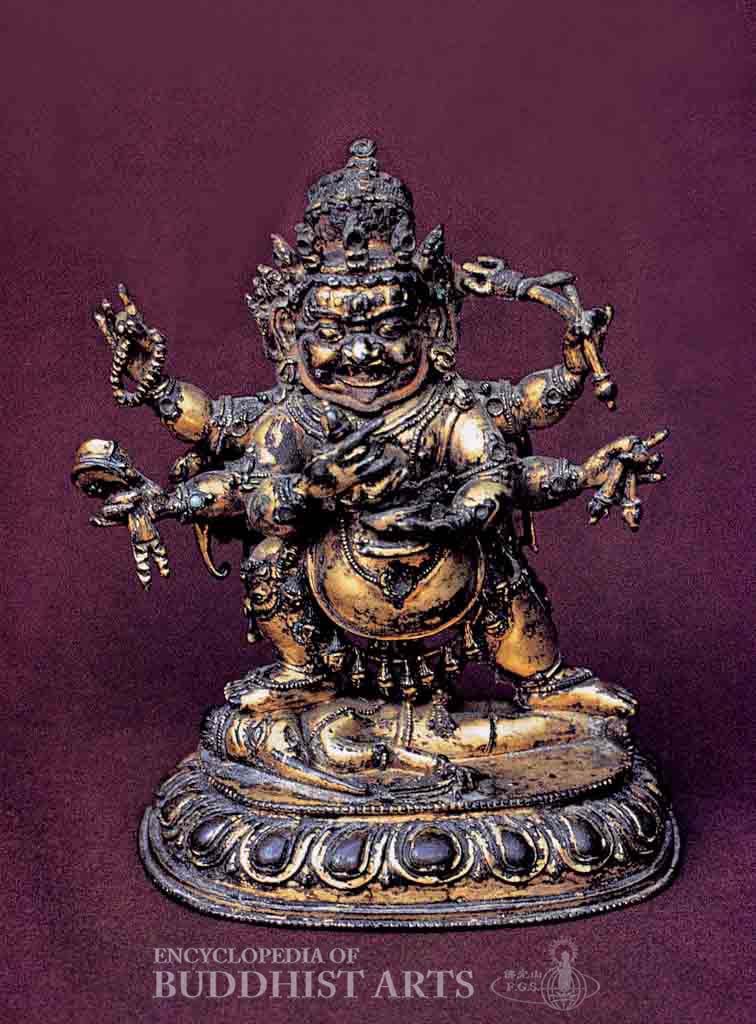
Gangzha Monastery: Six-Armed Mahakala
Gilt copper alloy
Gangzha Monastery: Six-Armed Mahakala
CHINA, Tibet, Qamdo
This ferocious looking Tibetan bronze sculpture dates from between the 17th and 18th centuries and represents the six-armed version of Mahakala. An elaborate crown surrounds the high topknot. A fringe beard surrounds the snarling mouth. The two main hands hold a skull cup and cleaver. The two remaining right hands hold prayer beads and a hand drum, while the left hands hold a trident and a snare. A garland of severed heads hangs below Mahakala’s sagging stomach as the figure assumes the warrior stance. An elephant-headed deity is crushed beneath the feet on the inverted lotus pedestal.
For more details, go to the Encyclopedia of Buddhist Arts: Sculpture G-M, page 369.
Cite this article:
Hsingyun, et al. "Gangzha Monastery: Six-Armed Mahakala." Encyclopedia of Buddhist Arts: Sculpture G-M, vol. 11, 2016, pp. 369.
Hsingyun, Youheng, Yann Lovelock, Yuan Chou, Susan Huntington, Gary Edson, and Robert Neather. 2016. "Gangzha Monastery: Six-Armed Mahakala" In Encyclopedia of Buddhist Arts: Sculpture G-M, 11:369.
Hsingyun, Youheng, Lovelock, Y., Chou, Y., Huntington, S., Edson, G., & Neather, R.. (2016). Gangzha Monastery: Six-Armed Mahakala. In Encyclopedia of Buddhist Arts: Sculpture G-M (Vol. 11, pp. 369).
@misc{Hsingyun2016,
author = Hsingyun and Youheng and Lovelock, Yann and Chou, Yuan and Huntington, Susan and Edson, Gary and Neather, Robert,
booktitle = {Encyclopedia of Buddhist Arts: Sculpture G-M},
pages = 369,
title = {{Gangzha Monastery: Six-Armed Mahakala}},
volume = 11,
year = {2016}}
author = Hsingyun and Youheng and Lovelock, Yann and Chou, Yuan and Huntington, Susan and Edson, Gary and Neather, Robert,
booktitle = {Encyclopedia of Buddhist Arts: Sculpture G-M},
pages = 369,
title = {{Gangzha Monastery: Six-Armed Mahakala}},
volume = 11,
year = {2016}}