
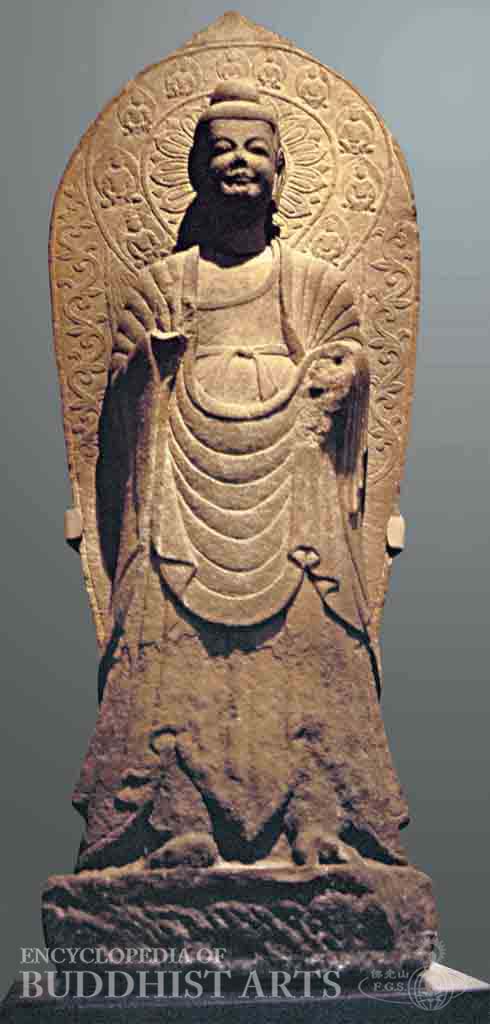
Standing Buddha
Stone
Standing Buddha
CHINA; Northern Qi dynasty
The Buddha wears an inner robe that is knotted high. Over this is a heavier monastic robe covering both shoulders, one end from which is draped over the broken left arm that probably displayed the varada (wish-granting) mudra. The right hand probably displayed the abhaya (fearlessness) mudra. Vertical ruffles at the bottom brake the ridged folds of the robe. A long lower garment continues the downward momentum and flares out around the ankles.
The Buddha’s head is tilted slightly upward, surmounted by smooth hair and a globular usnisa. Behind the head is a many petaled lotus nimbus surrounded by a wide circular band of ten seated Buddhas. A foliated mandorla runs upward from beneath the nimbus to interlock with its edge, bringing stability to the different patterns displayed in the work. The precise proportion of the figure display exceptional sculptural skills.
For more details, go to the Encyclopedia of Buddhist Arts: Sculpture St-Z, page 1134.
Cite this article:
author = Hsingyun and Youheng and Lovelock, Yann and Chou, Yuan and Huntington, Susan and Edson, Gary and Neather, Robert,
booktitle = {Encyclopedia of Buddhist Arts: Sculpture St-Z},
pages = 1134,
title = {{Standing Buddha}},
volume = 13,
year = {2016}}