
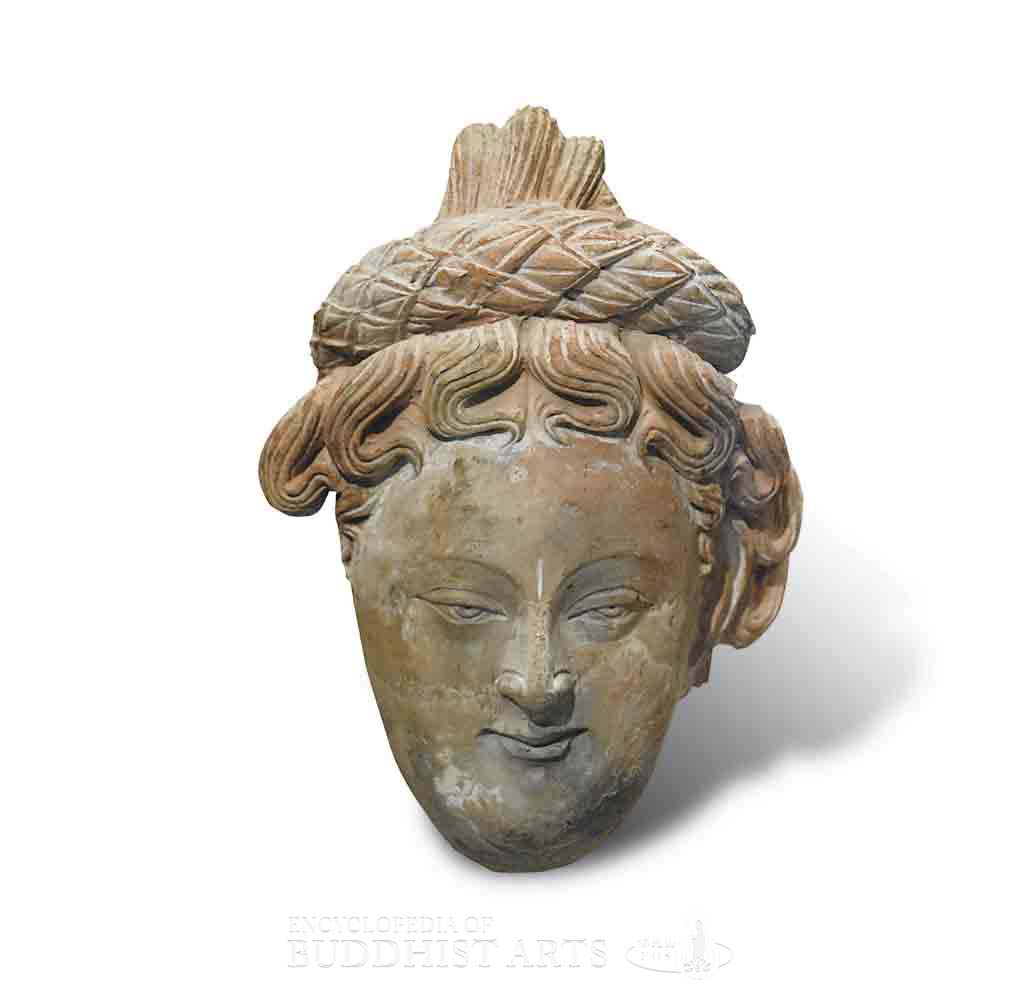
Duldur-Aqur: Head of a Bodhisattva
Clay
Duldur-Aqur: Head of a Bodhisattva
CHINA, Xinjiang, Aksu
The sculpture was unearthed from the Buddhist ruins of Duldur-Aqur. The face is elongated with centrally placed features that suggest they are the result of a face mold into which the clay was directly pressed leaving a high forehead and a long chin. The ridges of the eyebrows run directly into the nose, where the hollows behind the nostrils are sharply defined. The curled locks overhanging the brow are symmetrically modeled, and are interwoven with cloth and pulled free in braids to create an elaborate topknot. The sculpture was once painted but most of the paint has peeled off.
For more details, go to the Encyclopedia of Buddhist Arts: Sculpture A-F, page 304.
Cite this article:
Hsingyun, et al. "Duldur-Aqur: Head of a Bodhisattva." Encyclopedia of Buddhist Arts: Sculpture A-F, vol. 10, 2016, pp. 304.
Hsingyun, Youheng, Yann Lovelock, Yuan Chou, Susan Huntington, Gary Edson, and Robert Neather. 2016. "Duldur-Aqur: Head of a Bodhisattva" In Encyclopedia of Buddhist Arts: Sculpture A-F, 10:304.
Hsingyun, Youheng, Lovelock, Y., Chou, Y., Huntington, S., Edson, G., & Neather, R.. (2016). Duldur-Aqur: Head of a Bodhisattva. In Encyclopedia of Buddhist Arts: Sculpture A-F (Vol. 10, pp. 304).
@misc{Hsingyun2016,
author = Hsingyun and Youheng and Lovelock, Yann and Chou, Yuan and Huntington, Susan and Edson, Gary and Neather, Robert,
booktitle = {Encyclopedia of Buddhist Arts: Sculpture A-F},
pages = 304,
title = {{Duldur-Aqur: Head of a Bodhisattva}},
volume = 10,
year = {2016}}
author = Hsingyun and Youheng and Lovelock, Yann and Chou, Yuan and Huntington, Susan and Edson, Gary and Neather, Robert,
booktitle = {Encyclopedia of Buddhist Arts: Sculpture A-F},
pages = 304,
title = {{Duldur-Aqur: Head of a Bodhisattva}},
volume = 10,
year = {2016}}