
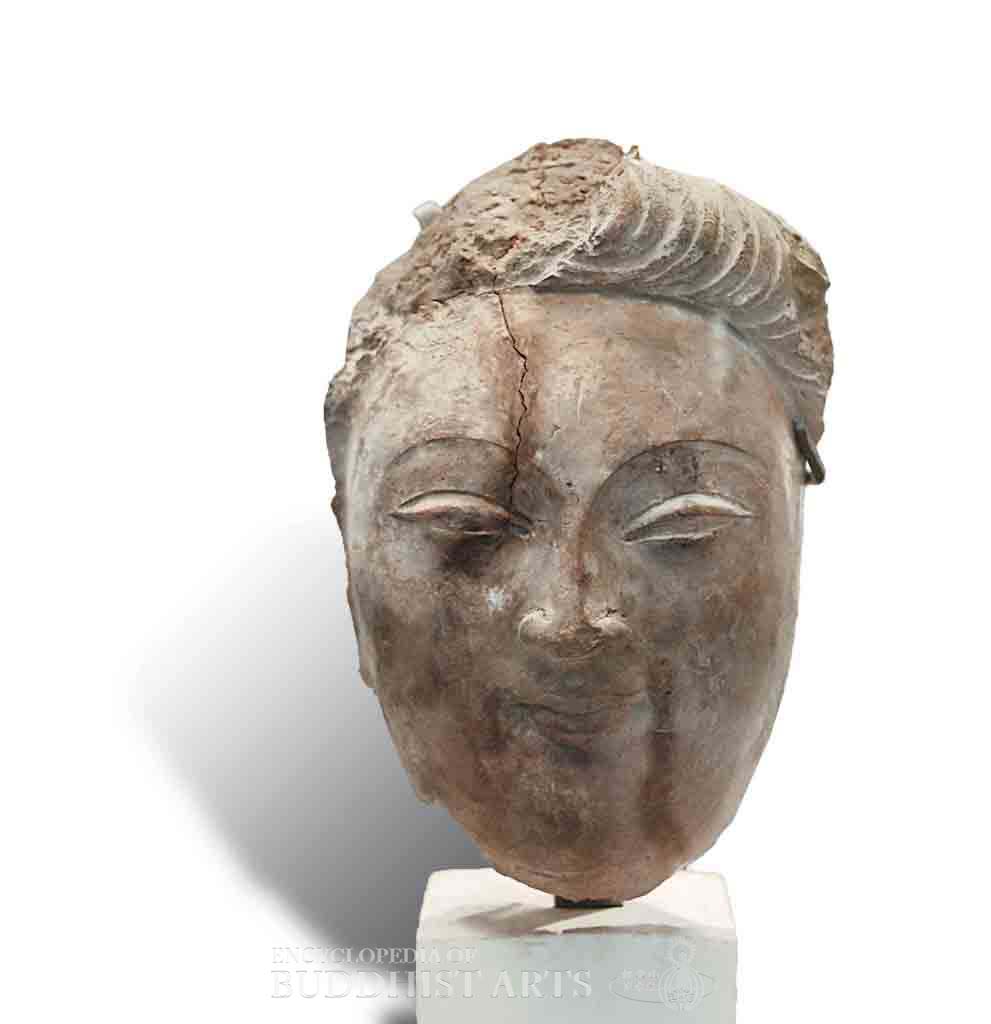
Tuokuzisalai Sculptures: Head of a Bodhisattva; 4th–5th century; Clay; H: 14.3 cm; Guimet Museum of Asian Art, Paris, France
Tuokuzisalai Sculptures
CHINA, Xinjiang, Kashgar
Tuokuzisalai was a caravan stop on the Silk Road’s northern route. It was a walled city, now in ruins, that contained a monastery complex with halls, stupas, and monastic residences. The city was part of the ancient kingdom of Kucha where Buddhism flourished. Muslims destroyed the site and archaeological excavations began there from near the start of the 20th century, resulting in numerous finds.
The sculptural styles and techniques came to the area from Gandhara. Various sculptural styles and types of feature were available as models because Tuokuzisalai was on the trade route and most notable were those from India, Sassanian, Persia, and China. The long eyes, broad nose, and small mouth are however, suggestive of Central Asia. Press molds were often used in Tuokuzisalai, as in other monastic workshops to form the face of unfired clay statues, resulting in smooth, centrally placed features with a pronounced chin, as in the figure illustrated. Details such as the hair were added and reworked to provide variety to each artwork.
A feature of the monastic site is sculpted murals, often of Jataka stories, in which individually sculpted figures are positioned along the wall. These creations show evidence of standardized molding.
For more details, go to the Encyclopedia of Buddhist Arts: Sculpture St-Z, page 1260.
Cite this article:
author = Hsingyun and Youheng and Lovelock, Yann and Chou, Yuan and Huntington, Susan and Edson, Gary and Neather, Robert,
booktitle = {Encyclopedia of Buddhist Arts: Sculpture St-Z},
pages = 1260,
title = {{Tuokuzisalai Sculptures}},
volume = 13,
year = {2016}}