
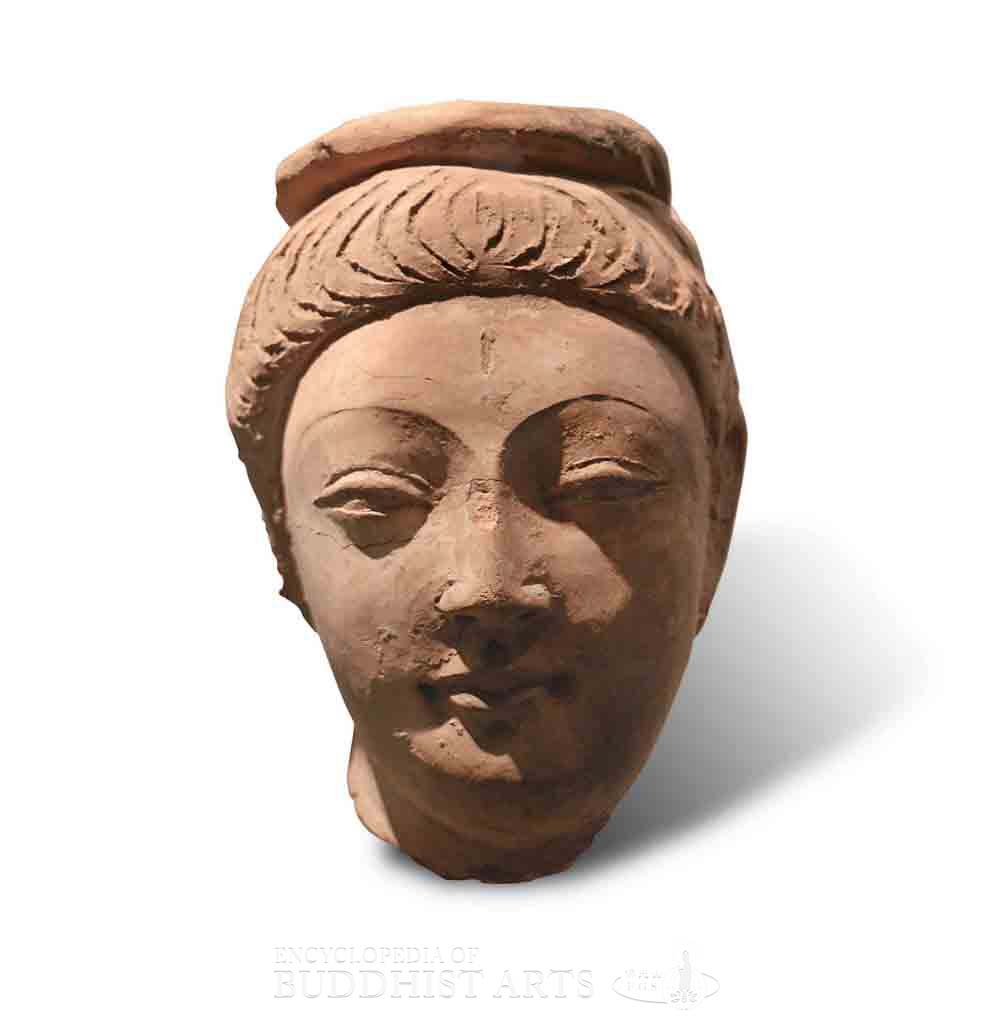
Tuokuzisalai Hall I: Head of a Bodhisattva
Clay
Tuokuzisalai Hall I: Head of a Bodhisattva
CHINA, Xinjiang, Kashgar
The head is a fragment from a wall relief with scenes from Buddhist history that was discovered during the first excavation of Tuokuzisalai in 1908 by the French explorer, Paul Pelliot. The features have been produced by use of a facial mold. Sharply impressed eyebrows run into the nasal ridge and the lengthened eyes are well defined. The mouth is more natural looking than some produced by this method but the rounded chin gives the impression of being over-full, which is a fault of the style. The head though mold-produced, has been given life by having a neck set at a slant, as though turning to look at the viewer. The hair was roughly worked by the sculptor’s tool; however, the flattened top may be where the head joined the decorated frame surrounding such reliefs.
For more details, go to the Encyclopedia of Buddhist Arts: Sculpture St-Z, page 1265.
Cite this article:
author = Hsingyun and Youheng and Lovelock, Yann and Chou, Yuan and Huntington, Susan and Edson, Gary and Neather, Robert,
booktitle = {Encyclopedia of Buddhist Arts: Sculpture St-Z},
pages = 1265,
title = {{Tuokuzisalai Hall I: Head of a Bodhisattva}},
volume = 13,
year = {2016}}