
Tivanka Image House: Mahasudassana Jataka
Tivanka Image House: Mahasudassana Jataka
SRI LANKA, North Central Province, Polonnaruwa; Polonnaruwa Kingdom
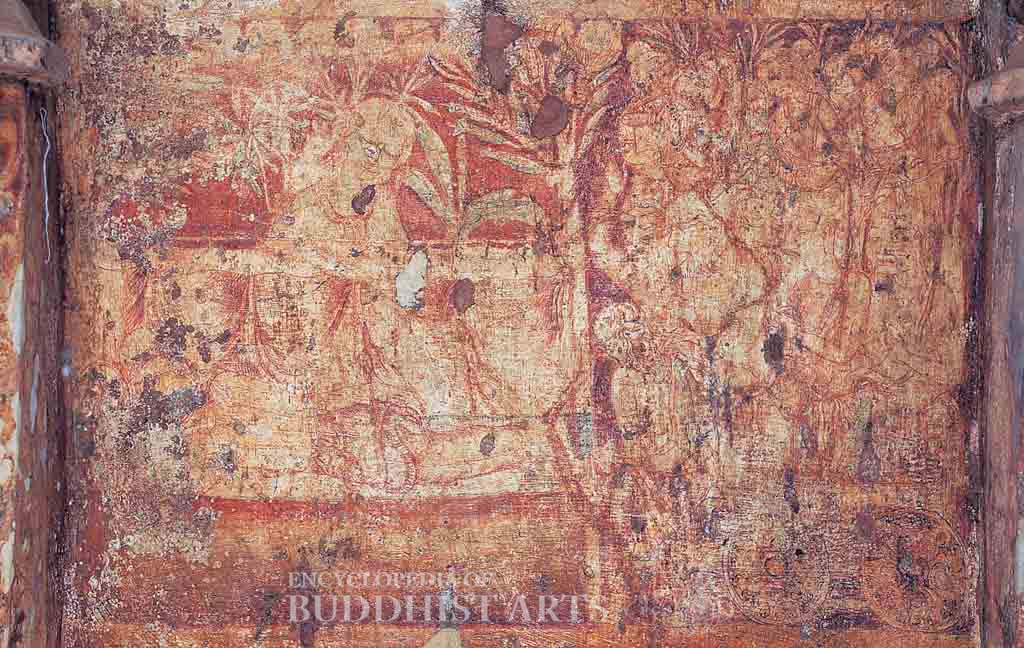
This mural is painted on the north wall of the portico at the Tivanka Image House in the ancient city of Polonnaruwa. Built during the mid-Polonnaruwa Kingdom, the Image House contains many Buddhist artworks. The murals in the portico and the front hall are mostly based on Jataka tales, while those in the main hall depict stories from the Life of the Buddha.
The story of King Mahasudassana is recorded in the Pali Jataka No. 95, the Mahaparinirvana Sutra, and the Madhyama Agama. According to these scriptures, Ananda asked the Buddha why he was choosing to pass into parinirvana near the small town of Kushinagar rather than in a great city like Rajagriha or Sravasti. The Buddha replied that Kushinagar was no ordinary town, and that in one of his previous lives, he had been King Mahasudassana of Kushinagar who possessed the four kinds of virtues and the seven treasures, and governed his kingdom with his four-fold army. The Buddha thus chose Kushinagar as the place where he would display the truth of impermanence with his final passing. In the mural, King Mahasudassana lies on a bed. His queen stands behind him. A crowd assembles on the right, and a carriage waits to transport the king’s corpse to the graveyard.
For more details, go to the Encyclopedia of Buddhist Arts: Painting P-Z, page 908.
Cite this article:
author = Hsingyun and Youheng and Youlu and Wilson, Graham and Manho and Mankuang and Huntington, Susan,
booktitle = {Encyclopedia of Buddhist Arts: Painting P-Z},
pages = 908,
title = {{Tivanka Image House: Mahasudassana Jataka}},
volume = 16,
year = {2016}}