
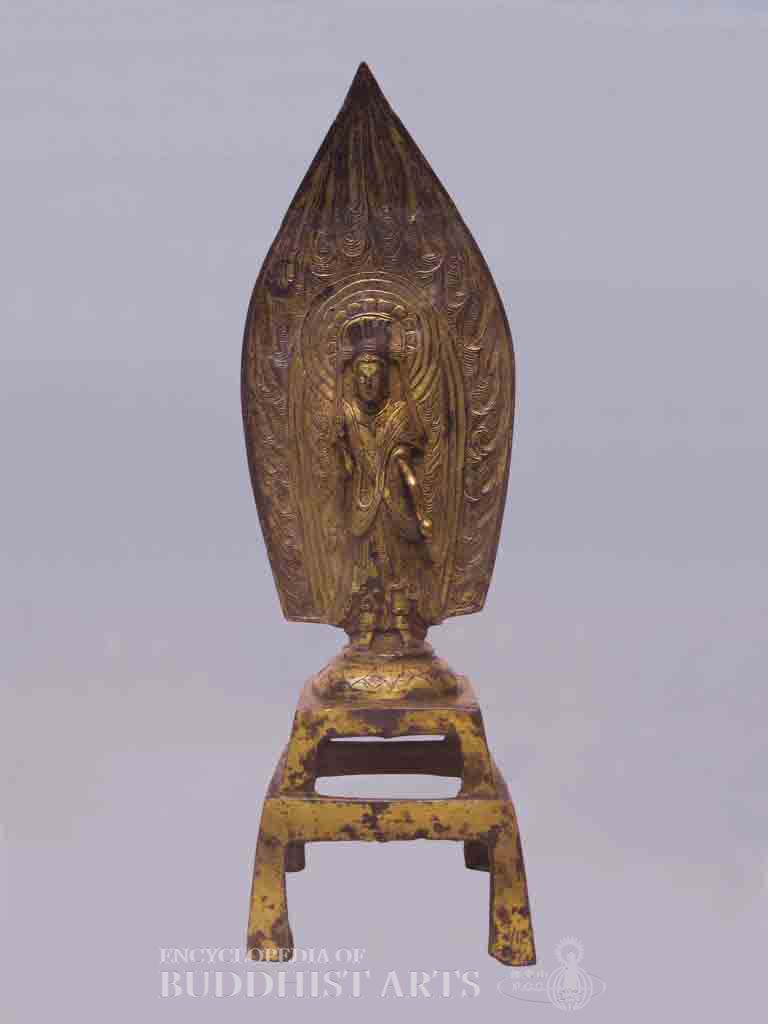
Avalokitesvara Bodhisattva
Gilt bronze
Avalokitesvara Bodhisattva
CHINA; Northern Wei dynasty
The Bodhisattva wears a high headdress with ribbons hanging symmetrically on both sides, a style that is characteristic of Avalokitesvara statues during the late Northern Wei dynasty (386–534). The two ends of a stole draping the shoulders cross at the abdomen and loop back to the waist. The right hand is raised in the abhaya (fearlessness) mudra while the left hand hangs downwards holding a vase. The lotus pedestal on which the figure stands is supported by a double-tier, four-legged stand. A circular nimbus merges with the aureole and both are enclosed by a petal-shaped mandorla decorated with flame patterns. According to the inscription engraved on the stand, the devotee Han commissioned the statue for his late father in 520.
For more details, go to the Encyclopedia of Buddhist Arts: Sculpture A-F, page 69.
Cite this article:
author = Hsingyun and Youheng and Lovelock, Yann and Chou, Yuan and Huntington, Susan and Edson, Gary and Neather, Robert,
booktitle = {Encyclopedia of Buddhist Arts: Sculpture A-F},
pages = 69,
title = {{Avalokitesvara Bodhisattva}},
volume = 10,
year = {2016}}