
Buddha Triad
Limestone
Buddha Triad
CHINA; Northern Wei dynasty
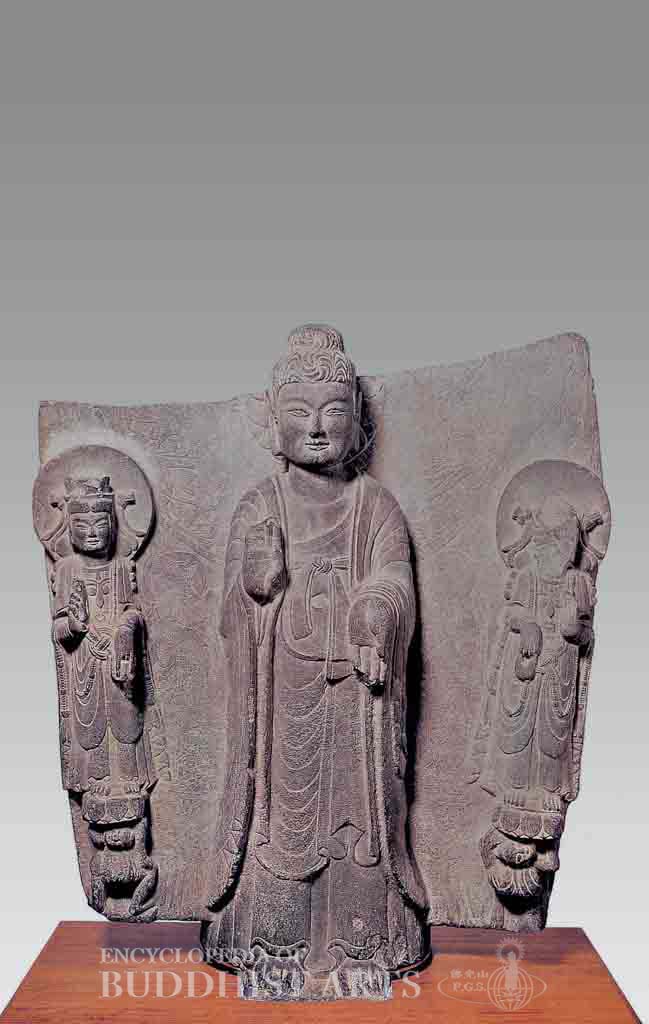
The Buddha wears a loose monastic robe secured at the chest by a knotted belt and with neatly depicted folds. The Buddha’s right hand makes the abhaya (fearlessness) mudra while the left hand forms the varada (wish-granting) mudra. The two smaller attendant Bodhisattvas are crowned and elaborately gowned. They stand upon lotus pedestals that are supported on the back of warriors. One of the Bodhisattva’s head has been damaged, as has been the mandorla, although details such as apsaras, flames, and lotuses are still visible. Å disciple is engraved on the mandorla between each Bodhisattva and the Buddha.
The entire sculpture, a fine work from the late Northern Wei dynasty (386–534), shows the transition from the slim figures portrayed during that dynasty to the fuller characteristic of the Eastern Wei dynasty (534–550).
For more details, go to the Encyclopedia of Buddhist Arts: Sculpture A-F, page 211.
Cite this article:
author = Hsingyun and Youheng and Lovelock, Yann and Chou, Yuan and Huntington, Susan and Edson, Gary and Neather, Robert,
booktitle = {Encyclopedia of Buddhist Arts: Sculpture A-F},
pages = 211,
title = {{Buddha Triad}},
volume = 10,
year = {2016}}