
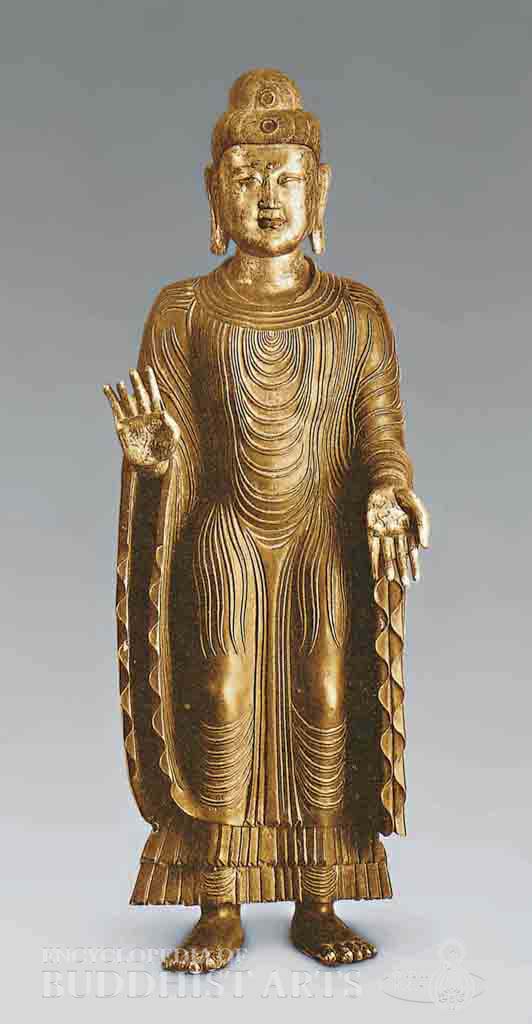
Udayana Buddha
Gilt copper alloy
Udayana Buddha
CHINA; Ming dynasty
It is recorded in Buddhist text when Sakyamuni Buddha visited Trayastrimsa Heaven for three months to teach his mother the Dharma, King Udayana missed him and commissioned a sandalwood sculpture. This story is the origination of the legendary Udayana Buddha image, an iconographic form that endured in China through to the Ming dynasty (1368–1644).
The figure wears a monastic robe that covers both shoulders and clings to the body. The distinctive folds descend concentrically to the waist, and divide vertically over the thighs. The robe falls to the feet in triple overlapping layers. The right hand is raised in the abhaya (fearlessness) mudra, while the left hand opens downwards in the varada (wish-granting) mudra.
For more details, go to the Encyclopedia of Buddhist Arts: Sculpture St-Z, page 1272.
Cite this article:
author = Hsingyun and Youheng and Lovelock, Yann and Chou, Yuan and Huntington, Susan and Edson, Gary and Neather, Robert,
booktitle = {Encyclopedia of Buddhist Arts: Sculpture St-Z},
pages = 1272,
title = {{Udayana Buddha}},
volume = 13,
year = {2016}}