
Stele
Limestone
Stele
CHINA; Western Wei dynasty
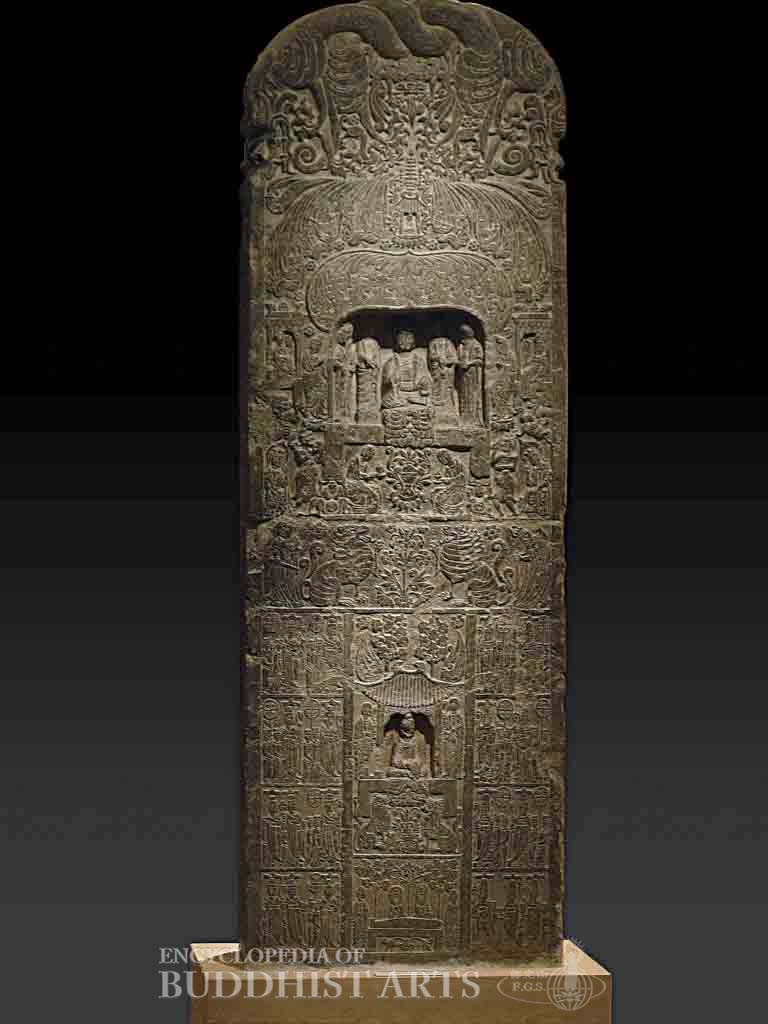
This work was thought to originate from Yuncheng, Shanxi. The backs of coiled dragons define the curved top of the stele, and the ornamental detail below merge into the representation of a pavilion’s roof. This arrangement forms an ogee shaped lintel above a niche, inside which are five figures: a seated Buddha, two disciples, and two Bodhisattvas, while other figures bow in reverence outside. Further scenes and decorative devices follow in raised relief bands below and on either side of a second Buddha in a pavilion with trees above and two donors outside. The dynamic work is admirably ordered and integrated. It is a rich example of decorative carving.
For more details, go to the Encyclopedia of Buddhist Arts: Sculpture St-Z, page 1163.
Cite this article:
author = Hsingyun and Youheng and Lovelock, Yann and Chou, Yuan and Huntington, Susan and Edson, Gary and Neather, Robert,
booktitle = {Encyclopedia of Buddhist Arts: Sculpture St-Z},
pages = 1163,
title = {{Stele}},
volume = 13,
year = {2016}}