
Henan: Buddha Triad
Limestone
Henan: Buddha Triad
Henan: Buddha Triad
CHINA, Henan; Northern Wei dynasty
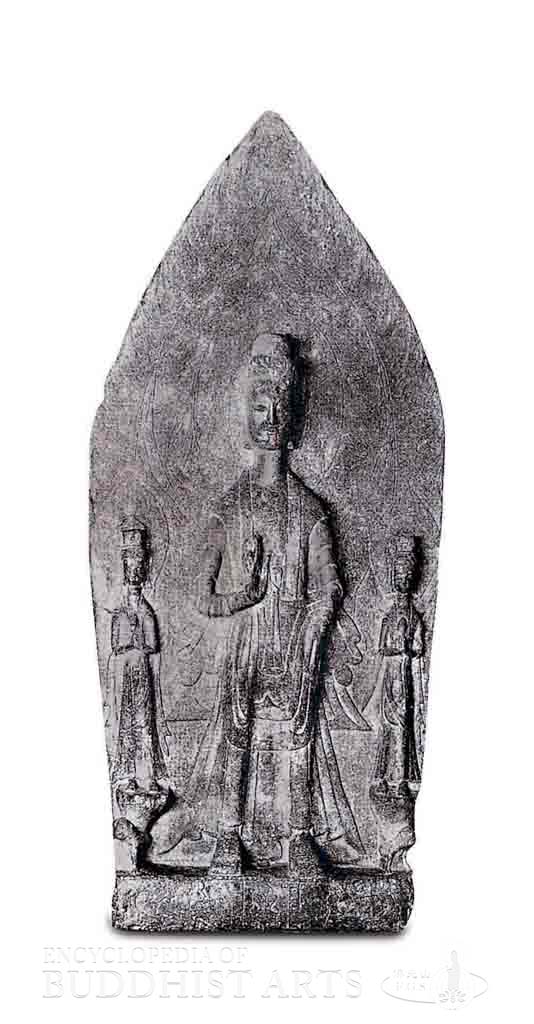
The triad was discovered in the northern part of Henan and has a Buddha flanked by two Bodhisattvas. Its style is reminiscent of the late Northern Wei dynasty (386–534).
At the center of the mandorla stands a Buddha with a high usnisa and an abnormally long neck. The figure holds the right hand in abhaya (fearlessness) mudra. The garment’s hem flares outwards from the waist in a style often seen in Northern Wei sculptures. A large nimbus with numerous bands is incised into the mandorla behind the Buddha’s head.
The attendant Bodhisattvas are equally thin as the central figure and they stand on lotus pedestals growing from the base. Their petal-shaped nimbuses smaller than the Buddha’s.
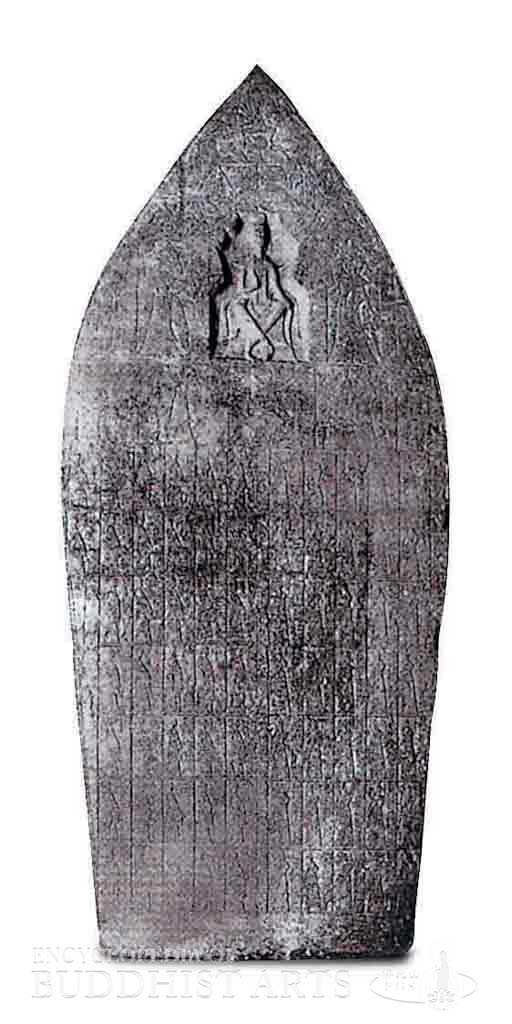
The reverse side of the sculpture is predominantly covered in rows of donors, all within their individual sections. A Bodhisattva seated with ankles crossed within an inset is located near the top. Like the three figures at the front, the Bodhisattva is also quite thin in appearance.
For more details, go to the Encyclopedia of Buddhist Arts: Sculpture G-M, page 427.
Cite this article:
author = Hsingyun and Youheng and Lovelock, Yann and Chou, Yuan and Huntington, Susan and Edson, Gary and Neather, Robert,
booktitle = {Encyclopedia of Buddhist Arts: Sculpture G-M},
pages = 427,
title = {{Henan: Buddha Triad}},
volume = 11,
year = {2016}}