
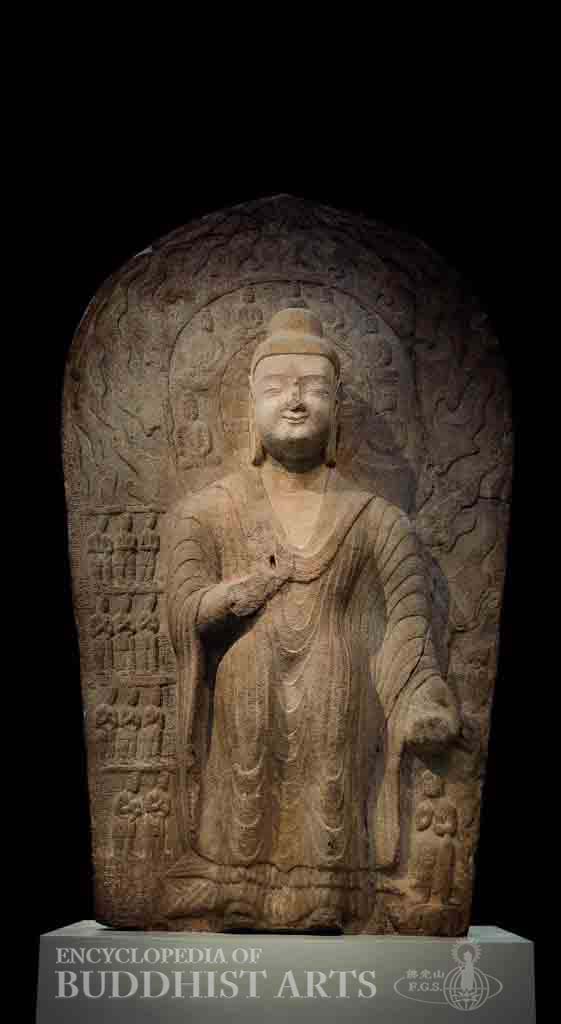
Dipamkara Buddha
Sandstone
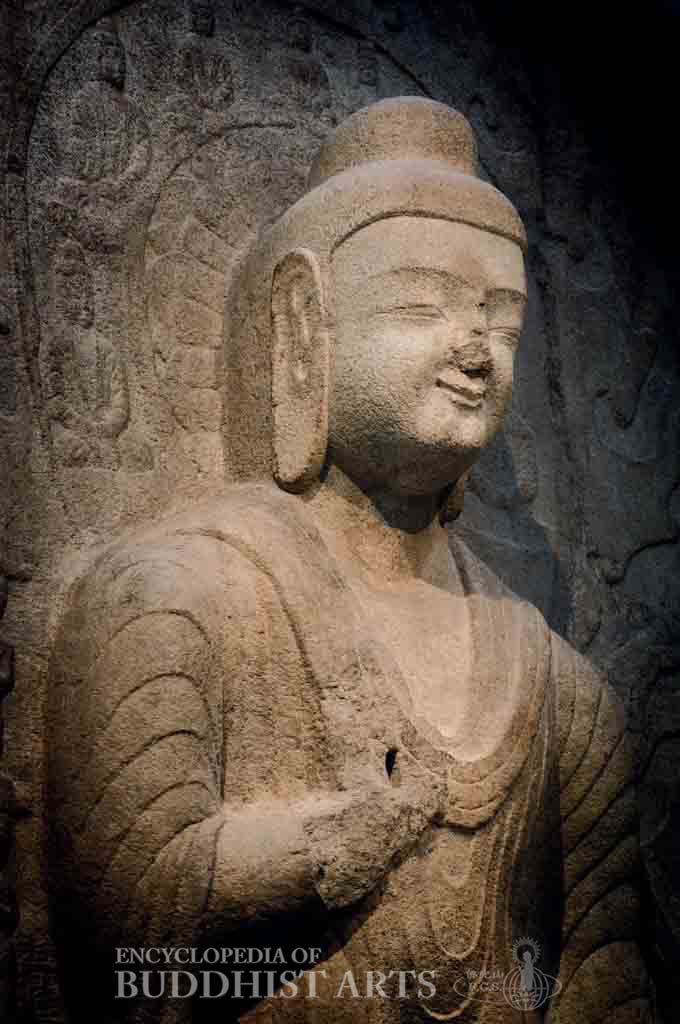
Dipamkara Buddha (detail)
Dipamkara Buddha
CHINA; Northern Wei dynasty
The body of Dipamkara is disproportionately short, with the left arm stretching well below the knee. The hanging hand is closed, a feature likely influenced by Indian art in which the robe is tightened about the arm. The garment covers both shoulders and is worn loosely, with deep folds falling from the forearms. Apart from the iconographic lengthening of the earlobes, the ears themselves are overly large, suggesting stylization was a greater priority to the sculptor than life-like representation. The treatment of the whole head, with its helmet-like hairline and usnisa, supports this assumption.
The mandorla is in the shape of a lotus petal and encloses a complex nimbus. Immediately behind the head is a lotus with many petals surrounded by seven seated Buddhas. The outer rim of the mandorla is decorated with flames at the top and figures of donors at the bottom. An inscription on the reverse side states the Zhao Ji and his family dedicated the sculpture in 495.
For more details, go to the Encyclopedia of Buddhist Arts: Sculpture A-F, page 293.
Cite this article:
author = Hsingyun and Youheng and Lovelock, Yann and Chou, Yuan and Huntington, Susan and Edson, Gary and Neather, Robert,
booktitle = {Encyclopedia of Buddhist Arts: Sculpture A-F},
pages = 293,
title = {{Dipamkara Buddha}},
volume = 10,
year = {2016}}