
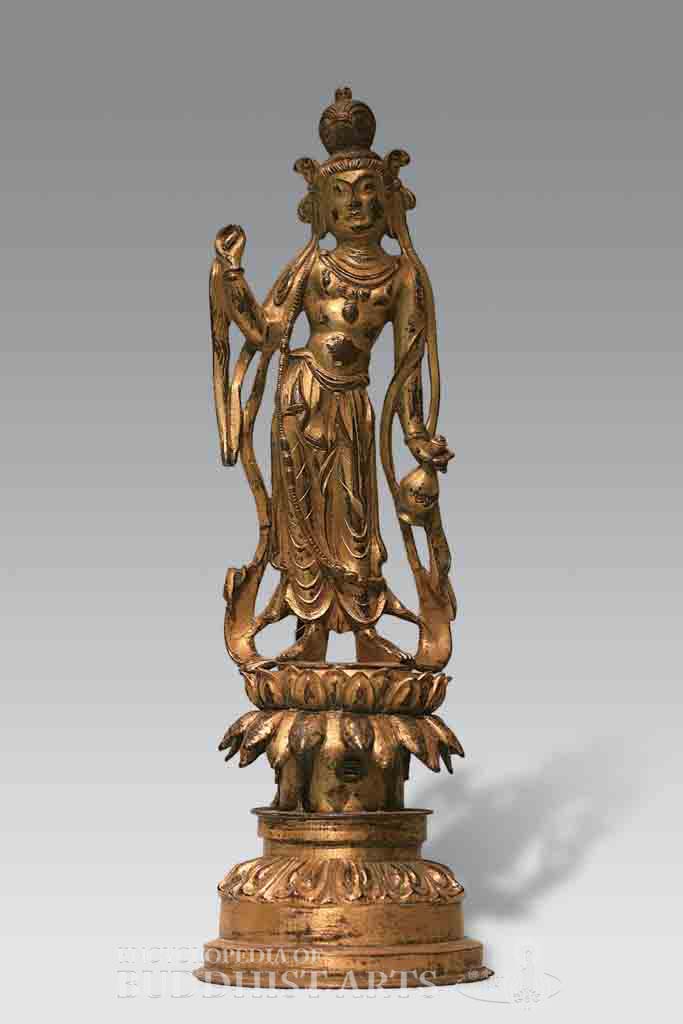
Standing Bodhisattva
Gilt bronze
Standing Bodhisattva
CHINA; Tang dynasty
The Bodhisattva stands in the dynamic tribhanga posture with head and waist tilting to one side to form a graceful curve, a form popular in the Tang dynasty. The elaborate topknot, in which the plaits are carefully delineated, is mounded on the head and culminates in a finial. Stoles wind about the arms in their descent to the pedestal. A jeweled necklace adorns the bared torso and a long bead ornament extends from the right shoulder over the vividly modeled skirt to the left shin. The right arm bends upwards, holding one corner of the double stole on that side. The lowered left hand holds a vase. The Bodhisattva stands with bare feet splayed on a double lotus pedestal supported by a reversed lotus base, so accentuating the figure’s upward thrust.
For more details, go to the Encyclopedia of Buddhist Arts: Sculpture St-Z, page 1118.
Cite this article:
author = Hsingyun and Youheng and Lovelock, Yann and Chou, Yuan and Huntington, Susan and Edson, Gary and Neather, Robert,
booktitle = {Encyclopedia of Buddhist Arts: Sculpture St-Z},
pages = 1118,
title = {{Standing Bodhisattva}},
volume = 13,
year = {2016}}