
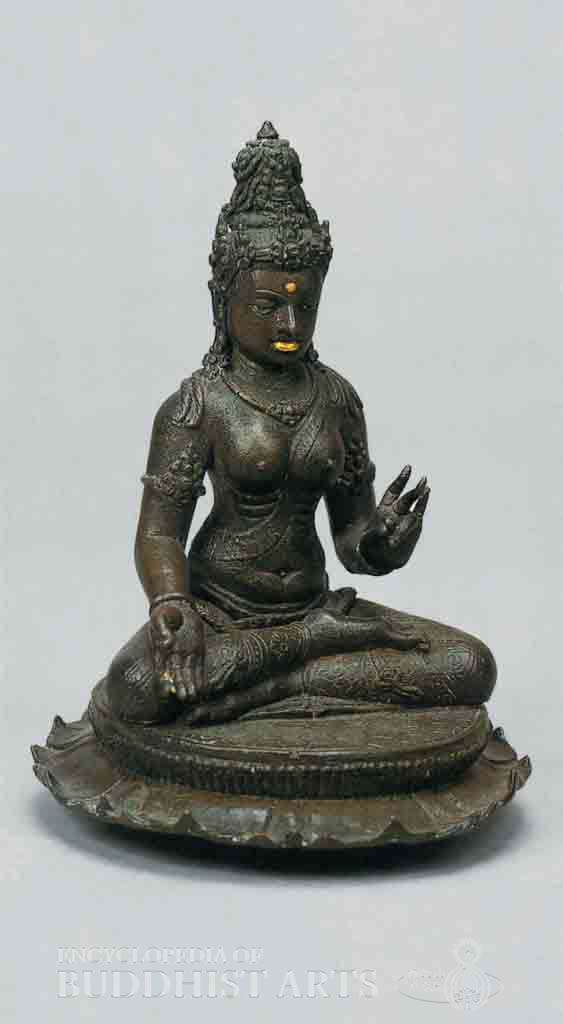
Java: Tara
Bronze
Java: Tara
INDONESIA, Central Java, Bumiayu
The sculpture was excavated from Bumiayu in Central Java, where Vajrayana Buddhism was widespread from the late 8th century onwards. Sculptures in this form are more common in eastern India or southeast Asia.
The richly jeweled Tara is seated in half lotus position. The eyes are inlaid with silver, while the urna and the lower lip are inlaid with gold. The figure wears a three-leaf crown with ornaments decorating the sides. The hair is built into a high topknot resembling a stupa, while stray locks fan out on the shoulders. The right hand is in varada (wish-granting) mudra while the left hand is raised. The lotus throne has petals bending away from the podded center.
For more details, go to the Encyclopedia of Buddhist Arts: Sculpture G-M, page 488.
Cite this article:
author = Hsingyun and Youheng and Lovelock, Yann and Chou, Yuan and Huntington, Susan and Edson, Gary and Neather, Robert,
booktitle = {Encyclopedia of Buddhist Arts: Sculpture G-M},
pages = 488,
title = {{Java: Tara}},
volume = 11,
year = {2016}}