
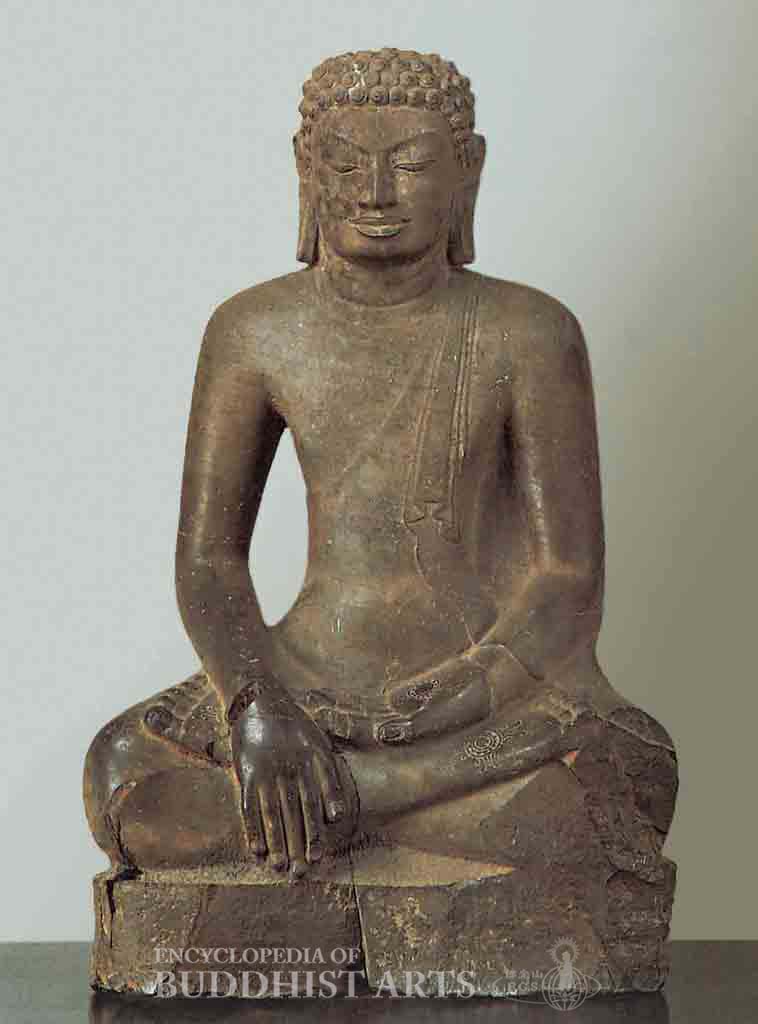
Buriram: Seated Buddha
Sandstone
Buriram: Seated Buddha
THAILAND, Buriram; Dvaravati Kingdom
This seated Buddha was excavated at Buriram. The facial characteristics, such as the abundant and neatly curled hair, raised eyebrows, broad nose, large full mouth, and long earlobes, are consistent with the style of the Dvaravati Kingdom (circa 6th–13th century). The square head and absence of a usnisa, together with the robust physique, however, are not consistent with the Dvaravati style, whose sculptures tend to feature a tall usnisa, oval face, and slim build.
The Buddha is seated in the full lotus position. The right hand forms the bhumisparsa (earth-touching) mudra, while the left hand rests on the lap. The symbol of the Dharma wheel is visible on the palm and soles of the feet. The Buddha wears a monastic robe that covers the left shoulder. The hemline drapes down the left shoulder in a rippling pattern. The lack of any other folds in the garment was most likely an influence from the Gupta (circa 320–550) style.
For more details, go to the Encyclopedia of Buddhist Arts: Sculpture A-F, page 229.
Cite this article:
author = Hsingyun and Youheng and Lovelock, Yann and Chou, Yuan and Huntington, Susan and Edson, Gary and Neather, Robert,
booktitle = {Encyclopedia of Buddhist Arts: Sculpture A-F},
pages = 229,
title = {{Buriram: Seated Buddha}},
volume = 10,
year = {2016}}