
Seated Buddha
Bronze
Seated Buddha
THAILAND
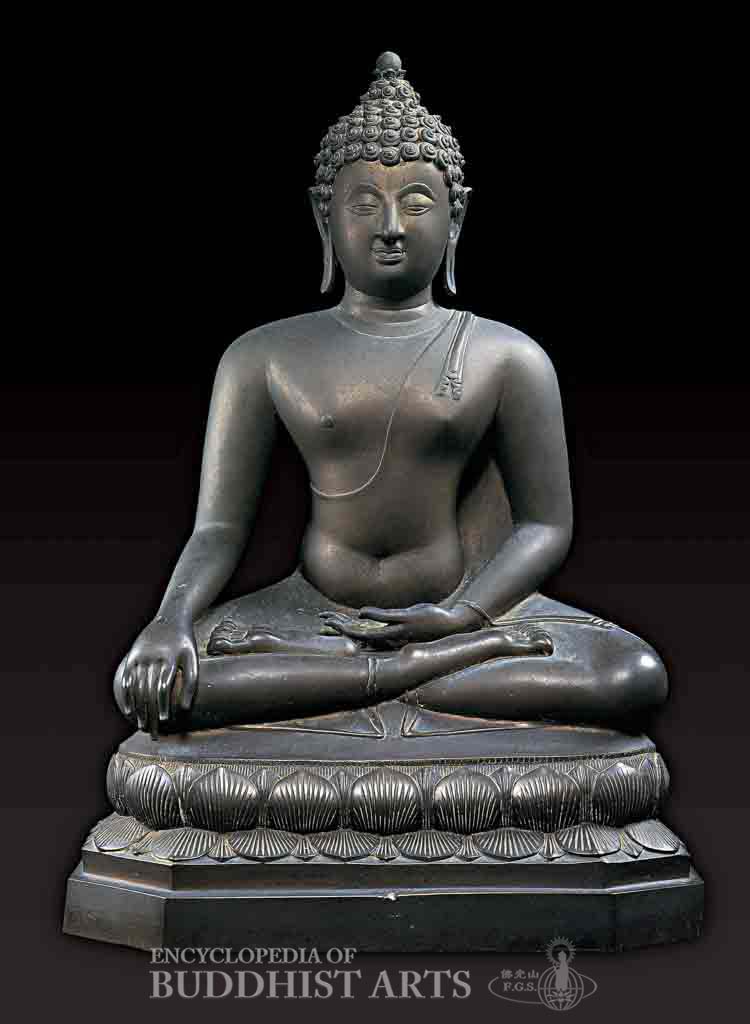
The Buddha is seated in full lotus position upon a lotus throne. The right hand is in bhumisparsa (earth-touching) mudra, with long elegant fingers stretched over the knee. The toes of the inverted feet are of the same size, and are one of the Buddha’s Thirty-Two Marks of Excellence. The Buddha’s conical usnisa is adorned with a jewel. The elongated earlobes curve slightly outwards on either side of the neck with its three lines. A thin monastic robe is worn that leaves the right shoulder bare. The strip of cloth represents the edge of the garment over the left shoulder.
The statue is considered a conventional example of the Phra Singh style seen in parts of northern Thailand and the Sukhothai area. A few elements such as the hand mudra, the jewel on the head, and the style of the robe are influenced by the styles of the Indian Pala period (circa 8th–12th century) as well as the Burmese Bagan Empire (circa 849–1287).
For more details, go to the Encyclopedia of Buddhist Arts: Sculpture N-Sr, page 1031.
Cite this article:
author = Hsingyun and Youheng and Lovelock, Yann and Chou, Yuan and Huntington, Susan and Edson, Gary and Neather, Robert,
booktitle = {Encyclopedia of Buddhist Arts: Sculpture N-Sr},
pages = 1031,
title = {{Seated Buddha}},
volume = 12,
year = {2016}}