
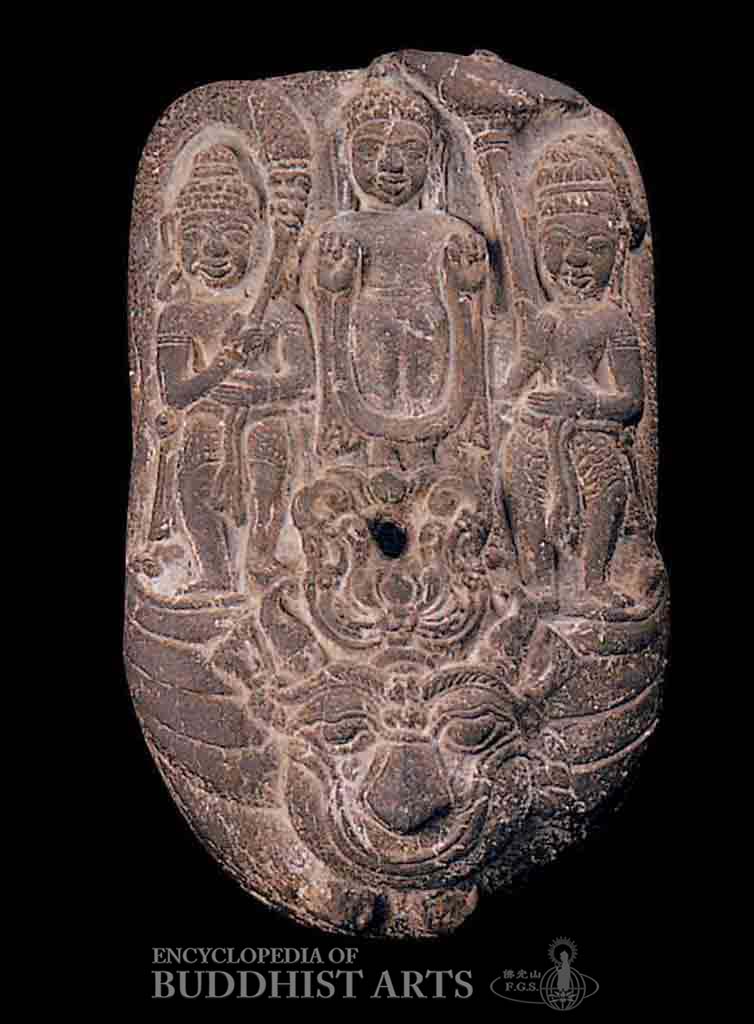
Buddha Triad
Stone
Buddha Triad
THAILAND
The Buddha, in the center, has hands likely raised in the vitarka (teaching) mudras. The hem of the robe hangs down from the arms and forms a U-shape, which is the conventional style of standing Buddhas from the Dvaravati Kingdom (circa 6th–13th century). The attendants on either side hold Dharma instruments and are thought to be either Brahma and Sakra, or Bodhisattvas. The three figures are riding on Panaspati, a mythical creature with the body of a bull, the wings of a swan, and the beak of a garuda. Since the bull, swan, and garuda are the vehicles of Shiva, Brahma, and Vishnu respectively, the image of the Buddha riding these vehicles suggests that Buddhism is portrayed here as transcending Hinduism.
This is one of the more interesting reliefs from the Dvaravati period and originally may have been an architectural ornament.
For more details, go to the Encyclopedia of Buddhist Arts: Sculpture A-F, page 220.
Cite this article:
author = Hsingyun and Youheng and Lovelock, Yann and Chou, Yuan and Huntington, Susan and Edson, Gary and Neather, Robert,
booktitle = {Encyclopedia of Buddhist Arts: Sculpture A-F},
pages = 220,
title = {{Buddha Triad}},
volume = 10,
year = {2016}}