
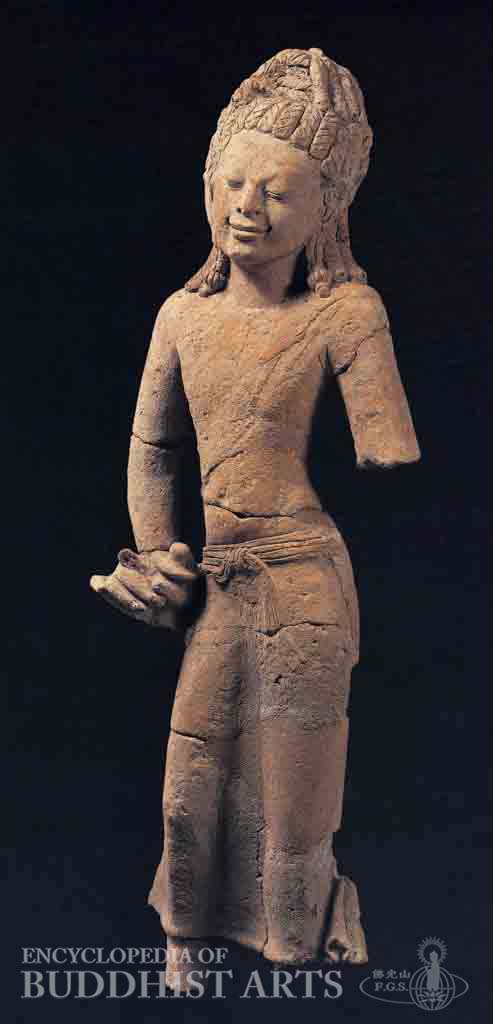
Khu Bua: Avalokitesvara Bodhisattva
Terracotta
Khu Bua: Avalokitesvara Bodhisattva
THAILAND, Ratchaburi, Khu Bua
This statue was among the numerous discoveries made in 1961 by the Thai Fine Arts Department among the ruins at Khu Bua. It indicates the prevalence of Mahayana Buddhism during the Dvaravati Kingdom (circa 6th–13th century).
The hair of the Bodhisattva is curled into ringlets and bundled into flat strips, then tied into a large knot on top of the head. Traces of a Buddha are still visible at the center of the topknot, suggesting that this sculpture is Avalokitesvara. The smiling head is tilted to one side, with high eyebrows and eyes that gaze downwards. The right hand at the waist holds the neck of a vase but the left forearm is damaged. The figure poses in the graceful tribhanga posture and wears a long lower garment which is belted at the waist, allowing the shape of the legs to show through. The pose is unusual for this Bodhisattva since most depictions around this time have Avalokitesvara in a rigid standing posture. An antelope-skin strap runs across the body, symbolizing the Bodhisattva’s ascetic practice.
For more details, go to the Encyclopedia of Buddhist Arts: Sculpture G-M, page 532.
Cite this article:
author = Hsingyun and Youheng and Lovelock, Yann and Chou, Yuan and Huntington, Susan and Edson, Gary and Neather, Robert,
booktitle = {Encyclopedia of Buddhist Arts: Sculpture G-M},
pages = 532,
title = {{Khu Bua: Avalokitesvara Bodhisattva}},
volume = 11,
year = {2016}}