
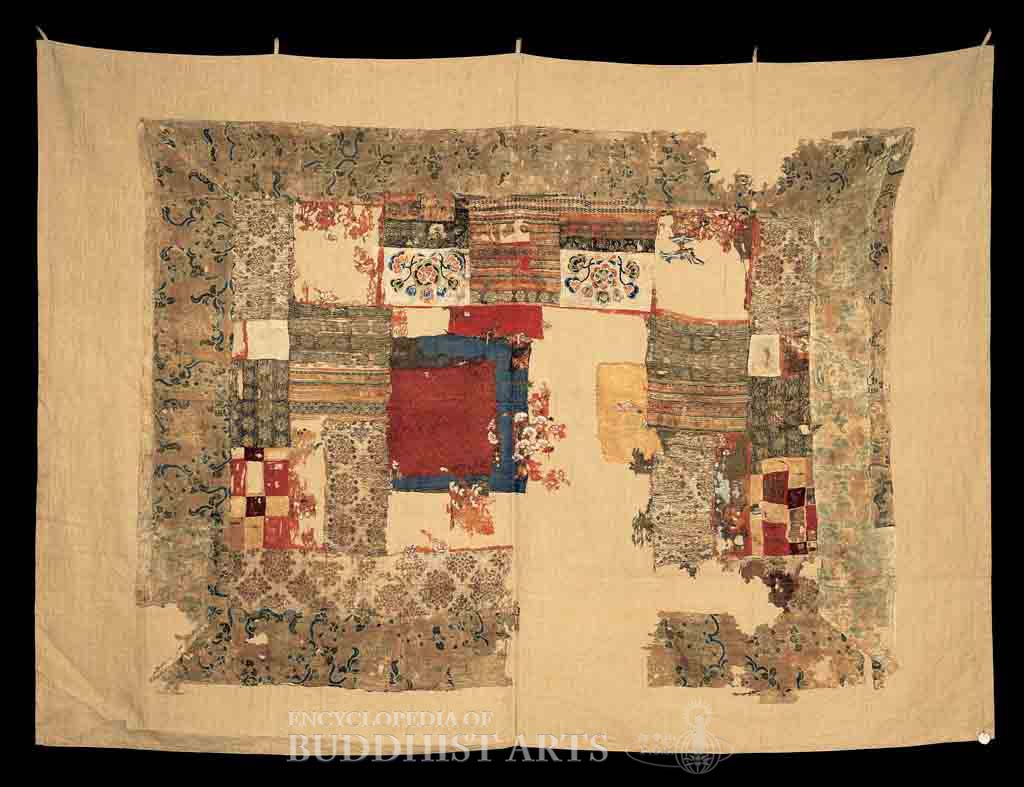
Mogao Cave 17: Patchwork
Silk
Mogao Cave 17: Patchwork
CHINA, Gansu, Dunhuang; Tang dynasty
Discovered in Mogao Cave 17 in Dunhuang, the original function of this patchwork textile is unclear; it bears semblance to the design of a kasaya, or monk’s robe, but given its size, some suggest that it could have served as a cover for a sutra, table, or bed. It was made between the 8th and 9th century during the Tang dynasty (618–907).
The cloth is rectangular and consists of two layers of fabric sewn together in seven patches of different colors, including two pieces of luxuriant purple silk. The surface is composed of various types of silk fabric, such as raw silk, brocade, and fine silk cloth. Embroidered with three-leaf patterns, blue long-tail birds, flowers, and butterflies, the majority of the surface and interior are considerably damaged.
For more details, go to the Encyclopedia of Buddhist Arts: Artifacts, page 201.
Cite this article:
author = Hsingyun and Youheng and Youji and Pokorski, Stefanie and Mankuang and Fan, Wen,
booktitle = {Encyclopedia of Buddhist Arts: Artifacts },
pages = 201,
title = {{Mogao Cave 17: Patchwork}},
volume = 18,
year = {2016}}