
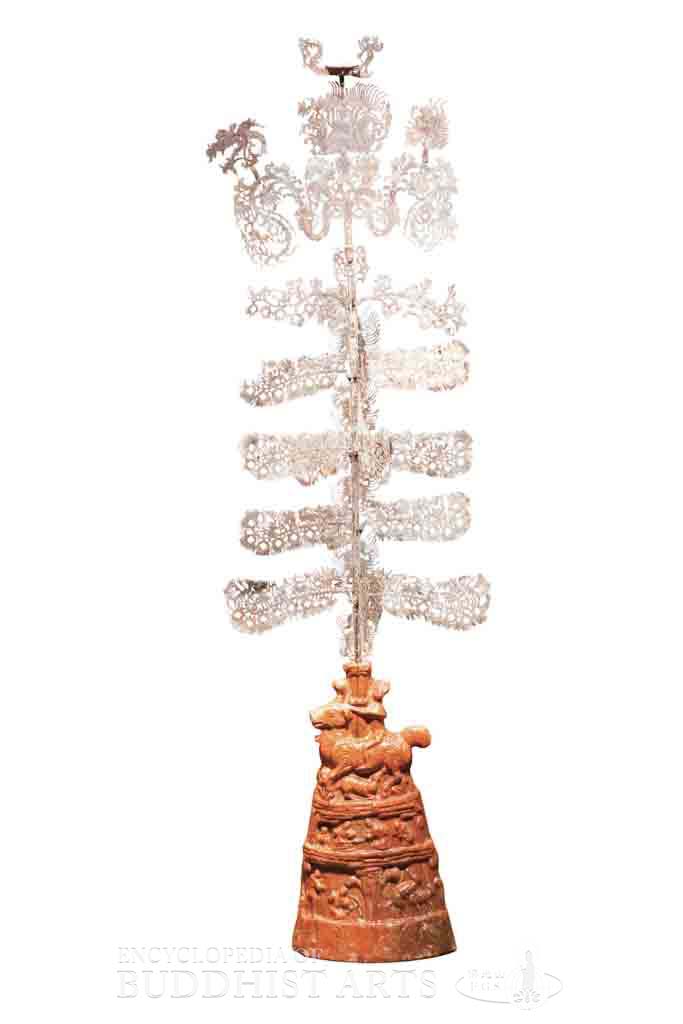
Buddha in the Money Tree
Bronze and earthenware
Buddha in the Money Tree
CHINA; Han dynasty
The money tree was a popular image during the Han dynasty (206 BCE–220 CE), in the Three Kingdoms period (220–280), and during the Jin dynasty (265–420). It was a burial object, which was believed could help the deceased to ascend to heaven. It was especially common in Sichuan.
The tree stands on a glazed red clay base, on top of which rides a mythical creature. Beneath the creature are reliefs depicting scenes of plowing and dancing. On either side of the tree, there are five branches decorated with copper coins, mythological figures, and dancing phoenixes. Above these branches is a miniature image of a seated Buddha. The seated image of the Queen Mother of the West appears near the top of the tree and has a dragon guarding her on the left, and a tiger on the right. Below her are two deities and a dragon’s head on the left and an angry monster on the right. Above the figure of the Queen Mother, there is a canopy followed by a small vessel for preparing the elixir of longevity.
For more details, go to the Encyclopedia of Buddhist Arts: Artifacts, page 22.
Cite this article:
author = Hsingyun and Youheng and Youji and Pokorski, Stefanie and Mankuang and Fan, Wen,
booktitle = {Encyclopedia of Buddhist Arts: Artifacts },
pages = 22,
title = {{Buddha in the Money Tree}},
volume = 18,
year = {2016}}