
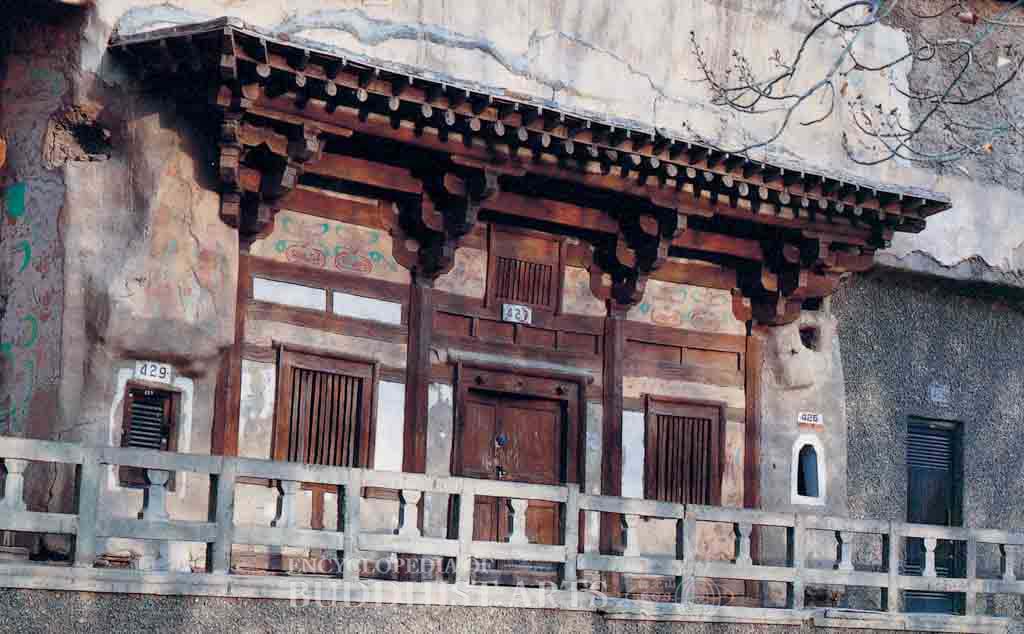
Mogao Cave 427
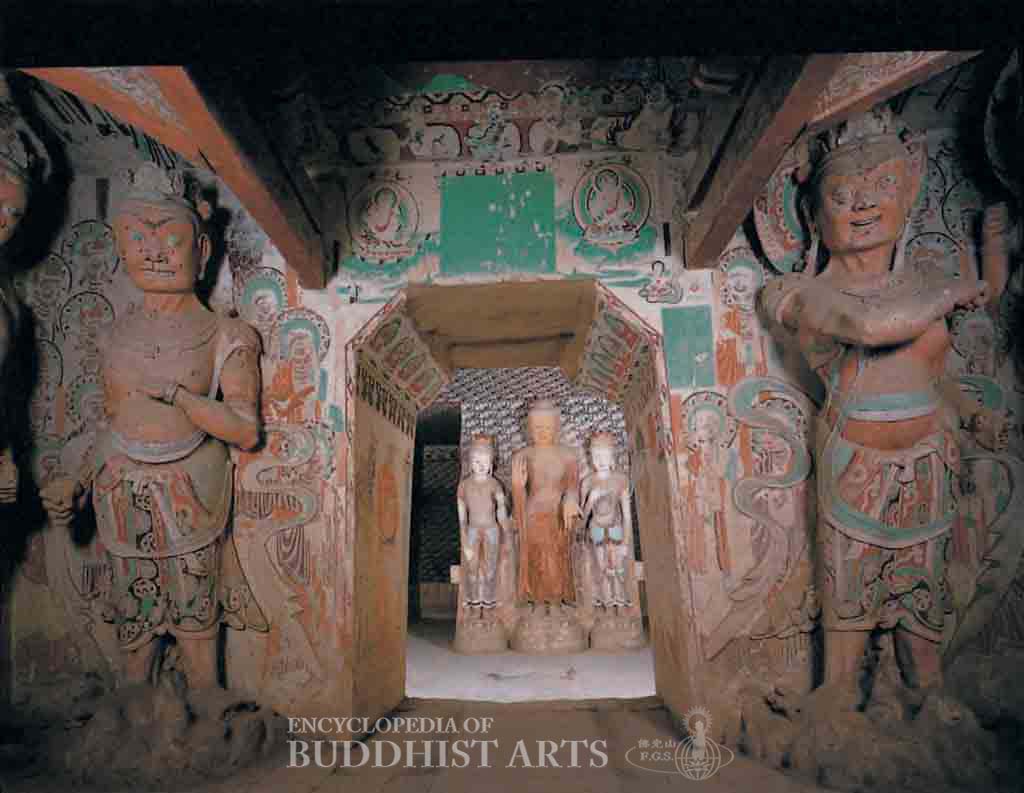
Mogao Cave 427: Antechamber
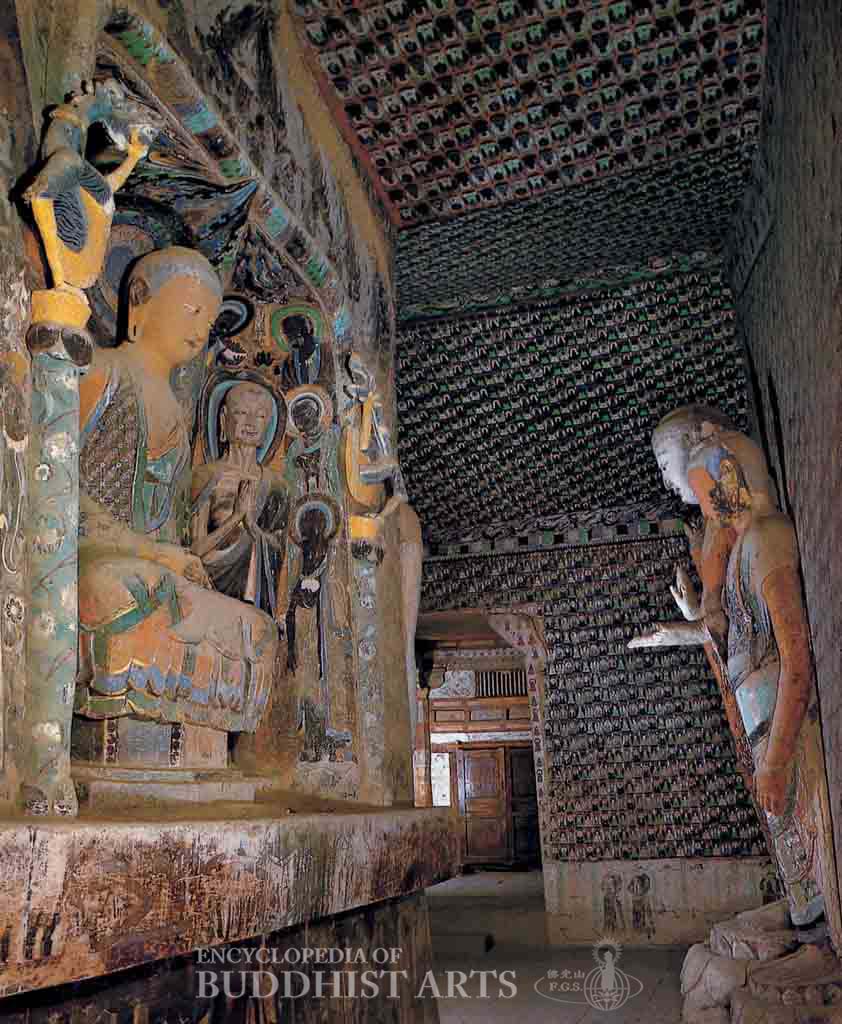
Mogao Cave 427: Main Chamber - Central Pillar (south side)
Mogao Cave 427
CHINA, Gansu, Dunhuang
Located in the south area of the Mogao Caves, this central pillar cave was constructed during the Sui dynasty (581–618) and restored during the Song dynasty (960–1279). It has an antechamber and a main chamber connected by a corridor. The antechamber measures 6.5 m in width, 3.4 m in height, and 4 m in depth. Much of the gabled ceiling is covered by eaves installed in the early Song dynasty. The eaves are some of the largest and the best preserved from that period. Ink inscriptions under the rafter beams indicate the wooden architecture was installed in 970 by Cao Yuanzhong. Besides the carved doors and the flying rafters, which were repaired in later dynasties, the rest of the installations are original. The three-tier brackets sets are in the style of the Tang dynasty (618–907). The eaves are flat and straight, unlike the upturned style which developed and became ubiquitous after the Song dynasty. Within the antechamber and flanking the entrance to the main chamber are statues of Vajrapanibalin and the Heavenly Kings, each approximately 3 m in height.
The main chamber is rectangular and measures 6.75 m in width, 5.5 m in height, and 10.55 m in depth. Thousand Buddhas are painted on the ceiling, which is gabled at the front and flat at the rear. A large central pillar houses niches on its north, south, and west sides, and each niche contains a seated Buddha and two disciples. A Buddha and two Bodhisattvas, with a 4 m high standing Buddha at the center, is situated on the east side of the pillar, as well as on the north and south walls of the main chamber. The four walls of the main chamber are painted with flying apsaras at the top, Thousand Buddhas in the center, and donors at the bottom. In the center of the back (west) wall as well as the left side of the north wall are illustrations of the Buddha teaching the Dharma, and an image of Vairocana Buddha is on the south wall.
For more details, go to the Encyclopedia of Buddhist Arts: Caves Mo-S, page 1204.
Cite this article:
author = Hsingyun and Youheng and Johnson, Peter and Mankuang and Huntington, Susan and Edson, Gary and Neather, Robert,
booktitle = {Encyclopedia of Buddhist Arts: Caves Mo-S},
pages = 1204,
title = {{Mogao Cave 427}},
volume = 8,
year = {2016}}