
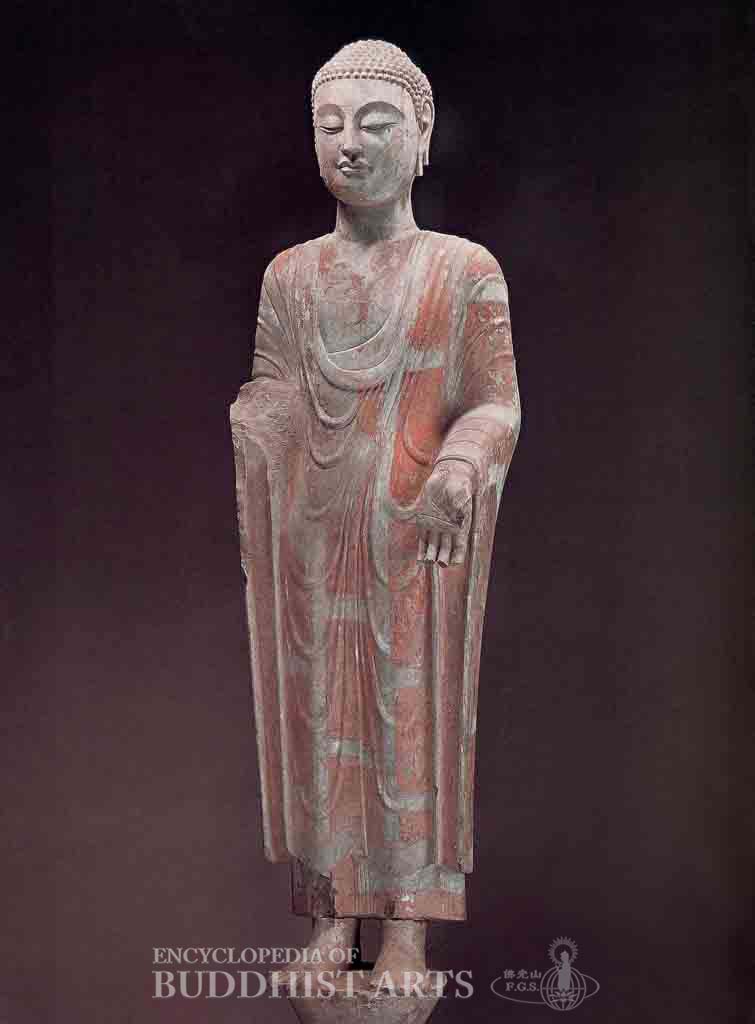
Longxing Temple: Standing Buddha
Limestone
Longxing Temple: Standing Buddha
CHINA, Shandong, Qingzhou; Northern Qi dynasty
The Buddha stands with his left hand in what is likely the varada (wish-granting) mudra while the right was probably in abhaya (fearlessness) mudra. The figure wears a low-collared monastic robe that covers both shoulders. The folds of the robe follow the shape of the body in raised contours, while its field-pattern cut is painted in red and blue. The serene face has sharply defined eyebrows that run into and help define the nose. The eyes are closed and the raised lips expressive. Tight curls build to a barely noticeable usnisa. The long earlobes are hollowed although the one on the right is broken.
For more details, go to the Encyclopedia of Buddhist Arts: Sculpture G-M, page 637.
Cite this article:
Hsingyun, et al. "Longxing Temple: Standing Buddha." Encyclopedia of Buddhist Arts: Sculpture G-M, vol. 11, 2016, pp. 637.
Hsingyun, Youheng, Yann Lovelock, Yuan Chou, Susan Huntington, Gary Edson, and Robert Neather. 2016. "Longxing Temple: Standing Buddha" In Encyclopedia of Buddhist Arts: Sculpture G-M, 11:637.
Hsingyun, Youheng, Lovelock, Y., Chou, Y., Huntington, S., Edson, G., & Neather, R.. (2016). Longxing Temple: Standing Buddha. In Encyclopedia of Buddhist Arts: Sculpture G-M (Vol. 11, pp. 637).
@misc{Hsingyun2016,
author = Hsingyun and Youheng and Lovelock, Yann and Chou, Yuan and Huntington, Susan and Edson, Gary and Neather, Robert,
booktitle = {Encyclopedia of Buddhist Arts: Sculpture G-M},
pages = 637,
title = {{Longxing Temple: Standing Buddha}},
volume = 11,
year = {2016}}
author = Hsingyun and Youheng and Lovelock, Yann and Chou, Yuan and Huntington, Susan and Edson, Gary and Neather, Robert,
booktitle = {Encyclopedia of Buddhist Arts: Sculpture G-M},
pages = 637,
title = {{Longxing Temple: Standing Buddha}},
volume = 11,
year = {2016}}