
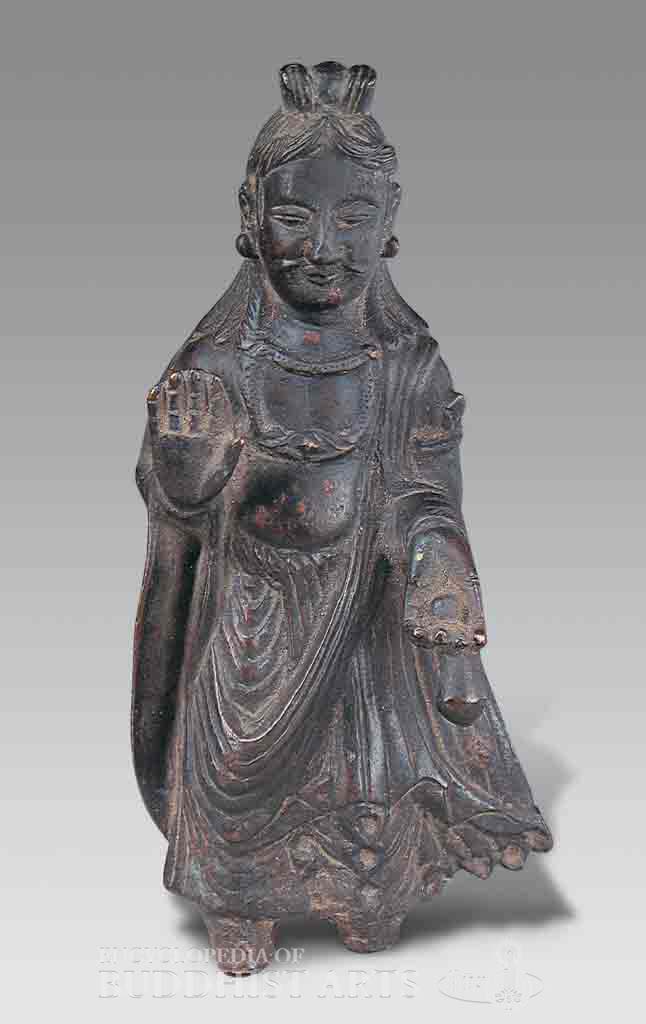
Standing Bodhisattva
Copper alloy
Standing Bodhisattva
CHINA; Sixteen Kingdoms
This is an early Buddhist artifact brought to China during the 4th century. The overall style is that of Gandhara. The right hand is in abhaya (fearlessness) mudra, where webbing is visible between the fingers, one of the Thirty-Two Marks of Excellence of a great person.
The Bodhisattva’s braided hair is arranged in a topknot, from which several locks tumble over the shoulders. The torso is mostly bare, with a wide stole wrapped round the left shoulder and arm with one end looping over the tucked skirt below to fold over the right forearm. An impression of movement is given by the slight inclination of the body, the forward position of the right leg and the way the robe flares outwards from the left leg. A mortise hole at the back of the head is mostly likely where a nimbus was fixed.
For more details, go to the Encyclopedia of Buddhist Arts: Sculpture St-Z, page 1109.
Cite this article:
author = Hsingyun and Youheng and Lovelock, Yann and Chou, Yuan and Huntington, Susan and Edson, Gary and Neather, Robert,
booktitle = {Encyclopedia of Buddhist Arts: Sculpture St-Z},
pages = 1109,
title = {{Standing Bodhisattva}},
volume = 13,
year = {2016}}