
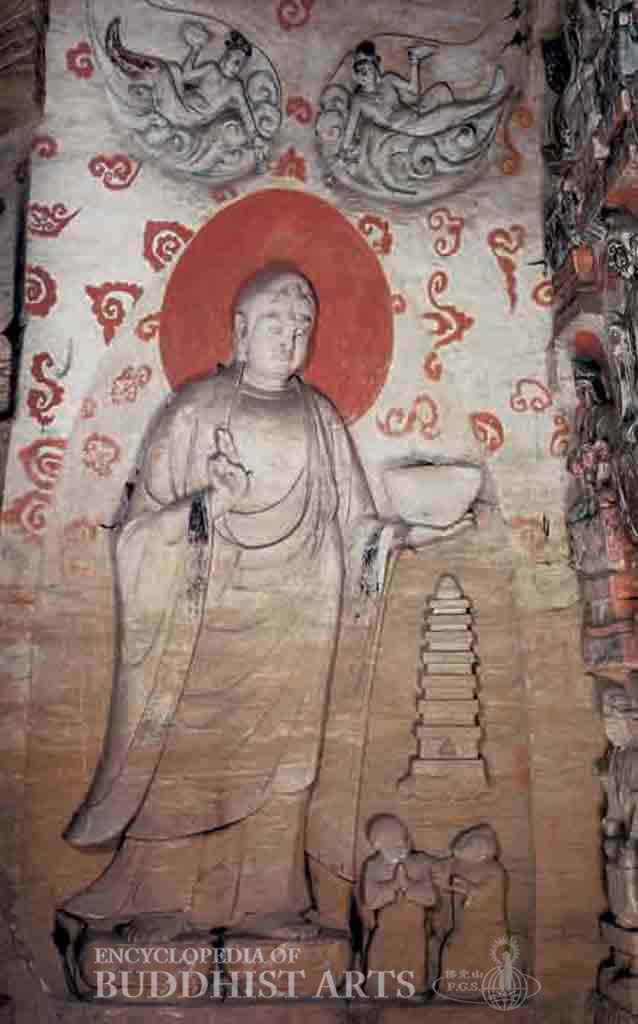
Shikong Temple Grotto: King Asoka Making a Sand Offering (north wall)
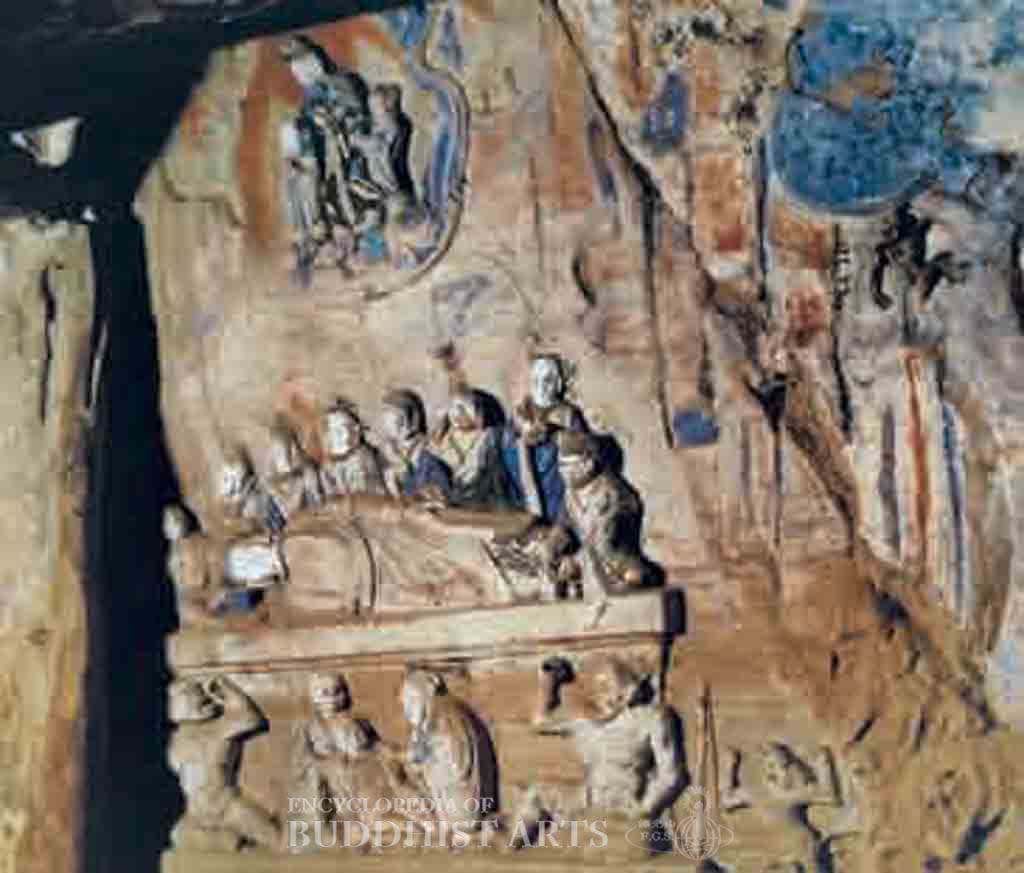
Shikong Temple Grotto: Reliefs
Shikong Temple Grotto
CHINA, Shaanxi, Yan’an
Situated in Huangling, Yan’an, this grotto is 9.5 m wide and 8.6 m deep with its entrance facing east. Inscriptions can be found from the Northern Song (960–1127) and Jin (1115–1234) dynasties. The grotto is listed as a Provincial Cultural Heritage Site.
The corridor leading into the grotto contains a number of relief carvings. The upper section mainly depicts images of parinirvana and the hells, while the lower section contains the Sixteen Arhats. There are also statues of various Bodhisattvas.
A Buddha altar is located in the center of the grotto. The west, north, and south sides of the altar extend up to the ceiling, forming a tall alcove. Statues of one Buddha and two disciples are found on the back (west) wall of the alcove. Carvings of a Buddha and two Bodhisattvas can be seen on the north and south walls. The back wall of the grotto has carvings of three groups of statues. The Five Hundred Arhats in the center are surrounded by stories from the Life of the Buddha. Additionally, the right side of the north wall has an illustration of King Asoka Making a Sand Offering. The illustration portrays a Buddha with a round face, solemn expression, and holding the right hand in front of the chest and a bowl in the left hand. Two apsaras are located above the Buddha’s nimbus. To the right of the Buddha is a seven-story pagoda, below which are two young figures. These carvings represent a scene from a past life of King Asoka, when he offered a sand pagoda to the Buddha.
For more details, go to the Encyclopedia of Buddhist Arts: Caves Mo-S, page 1369.
Cite this article:
author = Hsingyun and Youheng and Johnson, Peter and Mankuang and Huntington, Susan and Edson, Gary and Neather, Robert,
booktitle = {Encyclopedia of Buddhist Arts: Caves Mo-S},
pages = 1369,
title = {{Shikong Temple Grotto}},
volume = 8,
year = {2016}}