
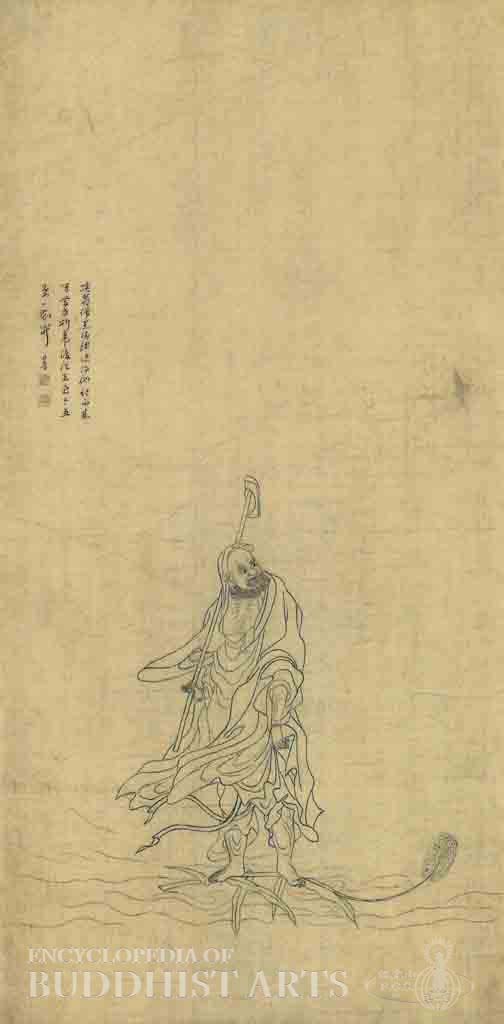
Qing Imperial Palace: Embroidery of Bodhidharma Crossing the River
Hair and silk
Qing Imperial Palace: Embroidery of Bodhidharma Crossing the River
CHINA, Beijing; Qing dynasty
This embroidery was created during the rule of Emperor Kangxi (reigned 1661–1722) of the Qing dynasty. It was originally kept in the imperial collection.
The image is made from human hair embroidered onto silk. Bodhidharma is depicted with a high forehead, thick eyebrows, deep-set eyes, large nose, and curly beard. He wears a hood and a long robe with wide sleeves and has earrings and bracelets. His left hand holds the robe and his right hand carries a staff with a monastic shoe at the end. He stands with bare feet on reeds that are floating away.
The embroidery forms an effect of simple line drawing, which captures the dynamic moment. Above the lone figure on the left, there are three columns of characters relating to the metaphorical crossing of the river by Bodhidharma and the subsequent flourishing of Buddhism in China.
For more details, go to the Encyclopedia of Buddhist Arts: Artifacts, page 250.
Cite this article:
author = Hsingyun and Youheng and Youji and Pokorski, Stefanie and Mankuang and Fan, Wen,
booktitle = {Encyclopedia of Buddhist Arts: Artifacts },
pages = 250,
title = {{Qing Imperial Palace: Embroidery of Bodhidharma Crossing the River}},
volume = 18,
year = {2016}}