
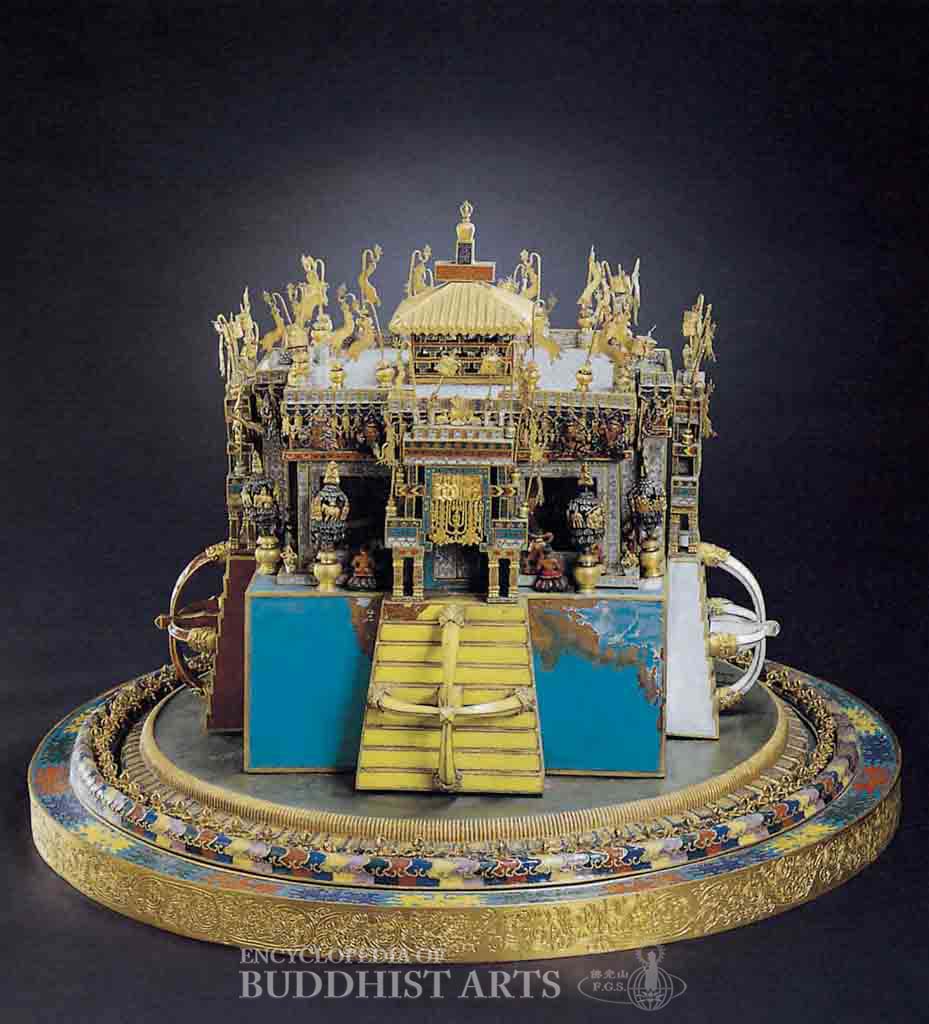
Qing Imperial Palace: Mandala
Gilt copper alloy and cloisonné
Qing Imperial Palace: Mandala
CHINA, Beijing; Qing dynasty
This mandala was created during the rule of Emperor Qianlong (reigned 1736–1795) of the Qing dynasty. It was previously kept in the collection of the imperial palace.
The mandala has a round base measuring 76 cm in diameter. The side of the base is gilded and engraved with vine patterns. On the upper part of the base, there are several circles representing different boundaries. The outer circle features lotus and vine patterns in red, blue, yellow, and green. The next circle consists of a flame wheel in red, blue, yellow, light purple, and green. The inner circle is a vajra wheel made of gilt copper.
A palatial building stands on a square base with stairways in red, yellow, blue, and white on all four sides, each leading to a door. There is a vajra on each of the four stairways, its color matching the stairway. The Tibetan-style palace has a flat roof with a Chinese-style golden building and a pyramidal roof on top. There is an image of Sakyamuni Buddha teaching the Dharma enshrined within the building. The palace is surrounded by gold vases and decorated with banners, canopies, and various Dharma instruments. Part of the exterior features colored cloisonne enamel.
This colorful and detailed mandala combines both metalwork and cloisonné enameling in a very effective manner.
For more details, go to the Encyclopedia of Buddhist Arts: Artifacts, page 253.
Cite this article:
author = Hsingyun and Youheng and Youji and Pokorski, Stefanie and Mankuang and Fan, Wen,
booktitle = {Encyclopedia of Buddhist Arts: Artifacts },
pages = 253,
title = {{Qing Imperial Palace: Mandala}},
volume = 18,
year = {2016}}