
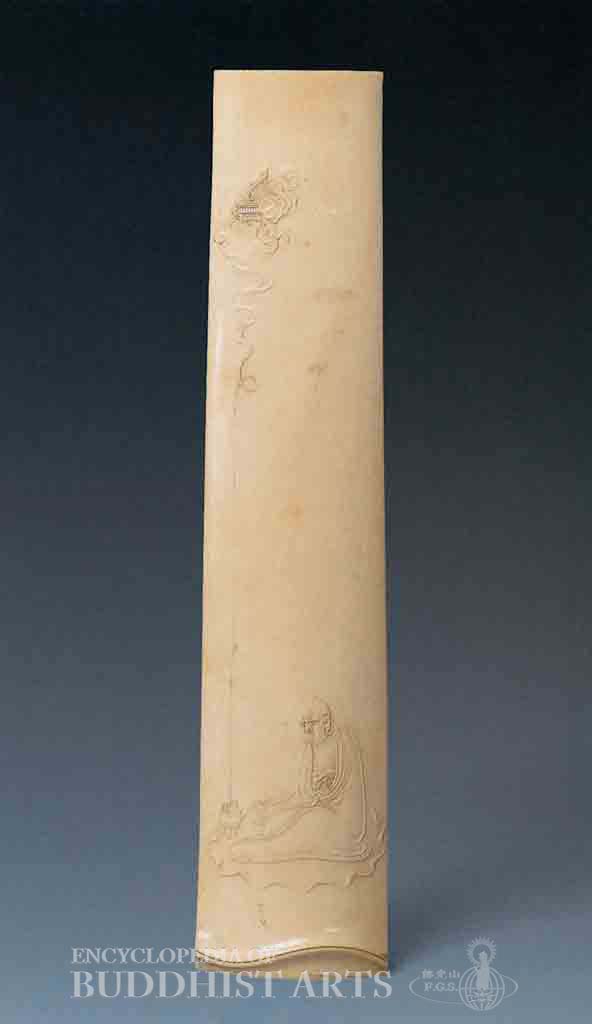
Qing Imperial Palace: Wrist Rest (front)
Ivory
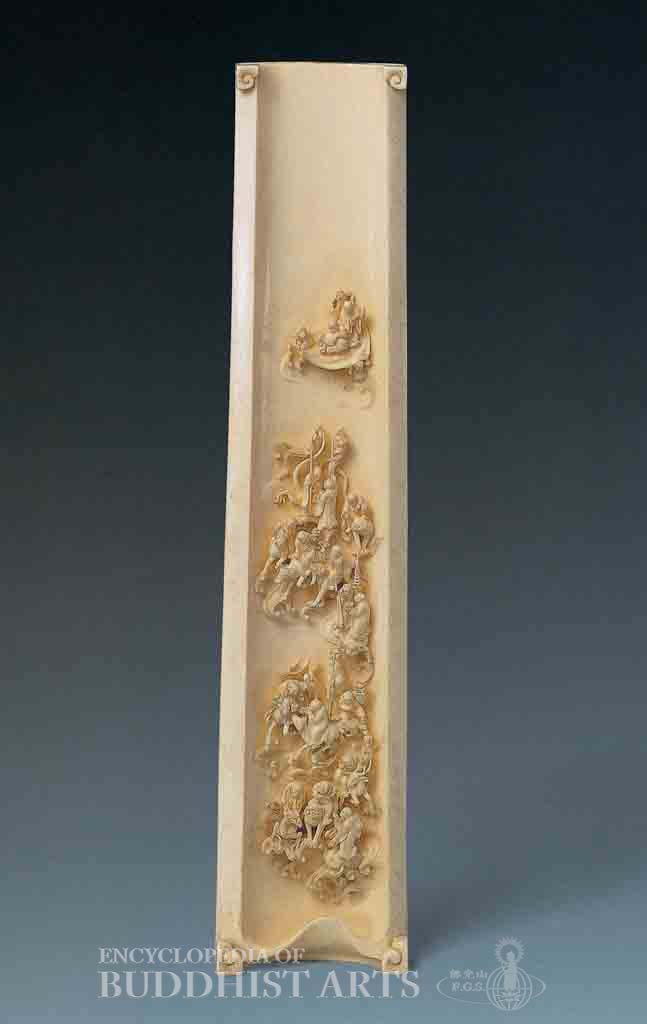
Qing Imperial Palace: Wrist Rest (back)
Qing Imperial Palace: Wrist Rest
CHINA, Beijing; Qing dynasty
Created in mid-Qing dynasty (1644–1911), this ivory wrist rest was originally kept in the imperial palace. It was used to support the wrist when writing with a brush.
The wrist rest is carved in imitation of bamboo, and on the outside, there is a relief of Bodhidharma sitting in contemplation facing an incense burner whose smoke reaches up to a temple in the clouds. He wears large earrings and has a high forehead, sunken eyes, an aquiline nose, and a tight-lipped mouth. A long robe covers both shoulders and envelops his whole body. There is a pile of sutras next to him.
The concave surface underneath has an image of Maitreya Bodhisattva at the top. A disciple stands behind the Bodhisattva and they appear on a silk cloth supported by three yaksas. Beneath Maitreya are the Eighteen Arhats, either standing or riding various creatures, engaging in different activities, and holding assorted Dharma instruments.
The wrist rest is both functional and aesthetically pleasing. The lively portrayal of Maitreya and the Arhats contrasts with the solitary Bodhidharma.
For more details, go to the Encyclopedia of Buddhist Arts: Artifacts, page 265.
Cite this article:
author = Hsingyun and Youheng and Youji and Pokorski, Stefanie and Mankuang and Fan, Wen,
booktitle = {Encyclopedia of Buddhist Arts: Artifacts },
pages = 265,
title = {{Qing Imperial Palace: Wrist Rest}},
volume = 18,
year = {2016}}