
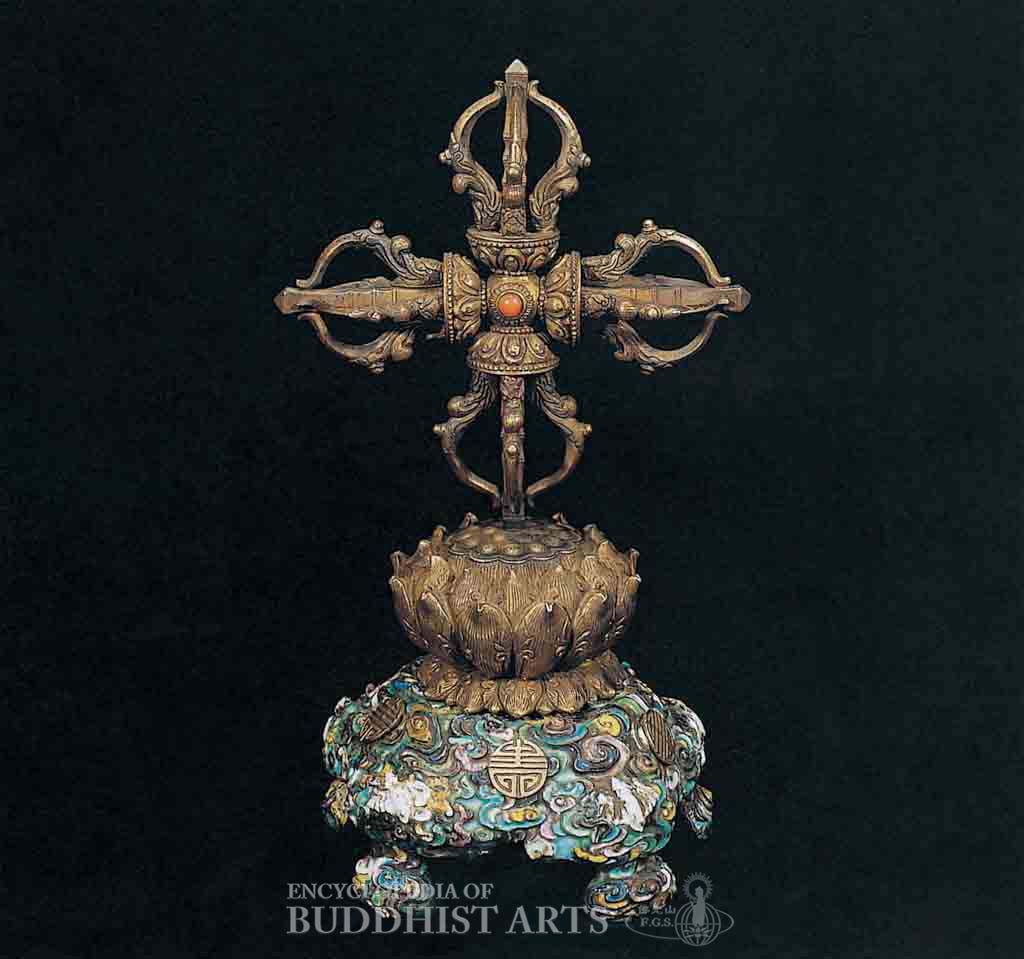
Qing Imperial Palace Cining Palace: Double Vajra
Gilt copper alloy
Qing Imperial Palace Cining Palace: Double Vajra
CHINA, Beijing; Qing dynasty
This Dharma instrument was originally kept in Cining Palace at the Qing Imperial Palace. A Vajra, which means “indestructible,” is an ancient Indian weapon known for its hardiness. In Tibetan Buddhism, the vajra represents the enlightened mind that eliminates defilement.
The center of this double vajra features a red gemstone surrounded by lotus petals, in which the four vajras are embedded. Each vajra has four inward-curving prongs, decorated with makaras, surrounding a straight central prong. The vajra sits on a lotus pedestal supported by a cloisonné in the form of a five-color floating cloud. The Chinese character for “longevity” is written on the base.
For more details, go to the Encyclopedia of Buddhist Arts: Artifacts, page 266.
Cite this article:
author = Hsingyun and Youheng and Youji and Pokorski, Stefanie and Mankuang and Fan, Wen,
booktitle = {Encyclopedia of Buddhist Arts: Artifacts },
pages = 266,
title = {{Qing Imperial Palace Cining Palace: Double Vajra}},
volume = 18,
year = {2016}}