
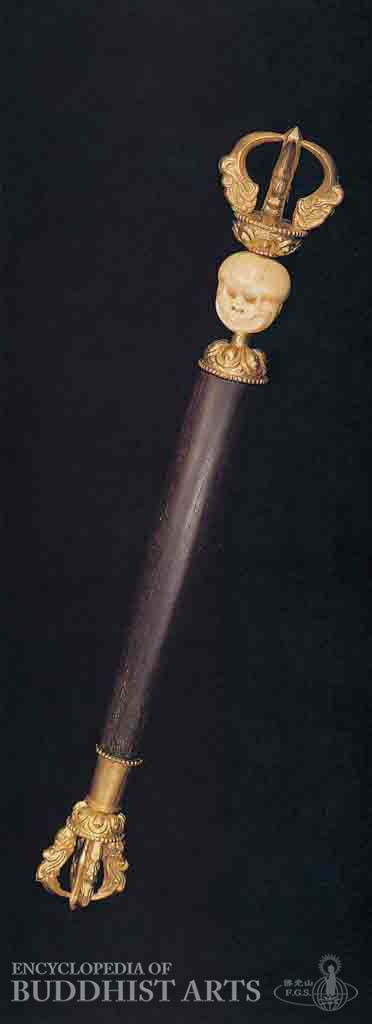
Qing Imperial Palace Cining Palace: Tantric Staff
Rosewood and gilt copper alloy
Qing Imperial Palace Cining Palace: Tantric Staff
CHINA, Beijing; Qing dynasty
This staff was used in the imperial palace during the Qing dynasty. The staff, also known as heavenly staff or skull staff, was used during Vajrayana Buddhist rituals.
Tantric staffs usually have three skulls showing different degrees of deterioration representing the three poisons of greed, anger, and ignorance. A variation to the traditional style, this staff has a single ivory skull. The shaft is made of rosewood. There is a five-prong vajra at the top, and a vajra lined with lotus petals and stringed beads at the bottom. The vajras are made from gilt copper alloy.
For more details, go to the Encyclopedia of Buddhist Arts: Artifacts, page 266.
Cite this article:
Hsingyun, et al. "Qing Imperial Palace Cining Palace: Tantric Staff." Encyclopedia of Buddhist Arts: Artifacts , vol. 18, 2016, pp. 266.
Hsingyun, Youheng, Youji, Stefanie Pokorski, Mankuang, and Wen Fan. 2016. "Qing Imperial Palace Cining Palace: Tantric Staff" In Encyclopedia of Buddhist Arts: Artifacts , 18:266.
Hsingyun, Youheng, Youji, Pokorski, S., Mankuang, & Fan, W.. (2016). Qing Imperial Palace Cining Palace: Tantric Staff. In Encyclopedia of Buddhist Arts: Artifacts (Vol. 18, pp. 266).
@misc{Hsingyun2016,
author = Hsingyun and Youheng and Youji and Pokorski, Stefanie and Mankuang and Fan, Wen,
booktitle = {Encyclopedia of Buddhist Arts: Artifacts },
pages = 266,
title = {{Qing Imperial Palace Cining Palace: Tantric Staff}},
volume = 18,
year = {2016}}
author = Hsingyun and Youheng and Youji and Pokorski, Stefanie and Mankuang and Fan, Wen,
booktitle = {Encyclopedia of Buddhist Arts: Artifacts },
pages = 266,
title = {{Qing Imperial Palace Cining Palace: Tantric Staff}},
volume = 18,
year = {2016}}