

Ivolginsky Monastery: Main Hall

Ivolginsky Monastery: Itigelov Palace
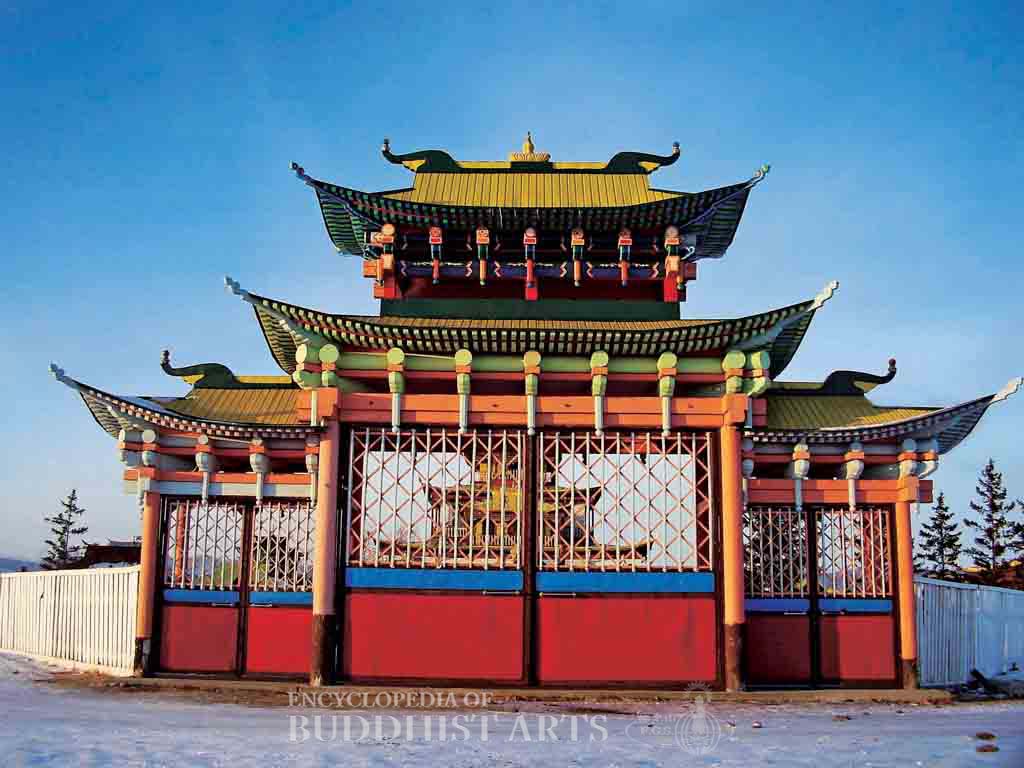
Ivolginsky Monastery: Main Temple Gate
Ivolginsky Monastery
RUSSIA, Buryatia, Ulan Ude
The monastery is located 30 km west of Ulan Ude and was built in 1945. It belongs to the Gelug school of Tibetan Buddhism. In 1995 it housed the Central Spiritual Buddhist Board of the Soviet Union. In 2002 the monastery received the full body relic of the famous lama Dasha Dorjo Itigelov, which drew much attention from the Buddhist community. It is now the residence of the Buddhist Traditional Sangha of Russia, as well as that of Pandido Khambo Lama, the head of Russian Buddhists. It is protected by the state as a cultural and religious monument.
The monastery faces south and consists of the main gate, main hall, Itigelov Palace, numerous stupas, a library, a hotel, the Museum of Buryat Art, and the Buddhist University, which Dashi Choinkhorling built in 1991. The monastery houses artifacts such as thangkas, sculptures, Dharma instruments, old Tibetan manuscripts of Buddhist sutras, and old Buryat works of art.
The main hall has two stories with a further story consisting of a pavilion on top. The first story has an open portico with vermilion columns supporting its roof. There is a Dharma wheel, a pair of deer, and two victory banners on the roof of the portico. Three flights of stairs lead up to three separate doors under the portico. On the second story there is a three-bay wide enclosed gallery with a hip-and-gable roof and upturned eaves. The pavilion on the third level has a small portico. It has a hip-and-gable roof with upturned eaves, and there is a miniature stupa and victory banners on the main ridge. The beams below the eaves on each story are painted in red with golden disks in Tibetan style. The interior of the hall is elaborately and colorfully decorated. The columns are painted with dragons, while murals and reliefs of many Jataka tales fill the interior. The pavilion on the third level houses the remains of Dashi Dorzho Itigelov, and is open to the public for only seven days each year.
The Itigelov Palace is located northwest of the main hall. It is two stories high and has a double-eave hip-and-gable roof with green tiles. The corners of the eaves have golden heads of makaras. An enclosed gallery projects from the front of the second story, while on the first story there is a portico with three doors flanked by latticed windows. The stairway leading up to the portico is lined with two rows of prayer wheels. The Itigelov Palace stands out among the buildings in the monastery, as its rafters, bracket sets, doorways and windows are all painted in bright colors of red, blue or green.
For more details, go to the Encyclopedia of Buddhist Arts: Architecture G-L, page 495.
Cite this article:
author = Hsingyun and Youheng and Johnson, Peter and Mankuang and Lancaster, Lewis,
booktitle = {Encyclopedia of Buddhist Arts: Architecture G-L},
pages = 495,
title = {{Ivolginsky Monastery}},
volume = 2,
year = {2016}}