
Stupa
Gilt copper alloy
Stupa
CHINA; Ming dynasty
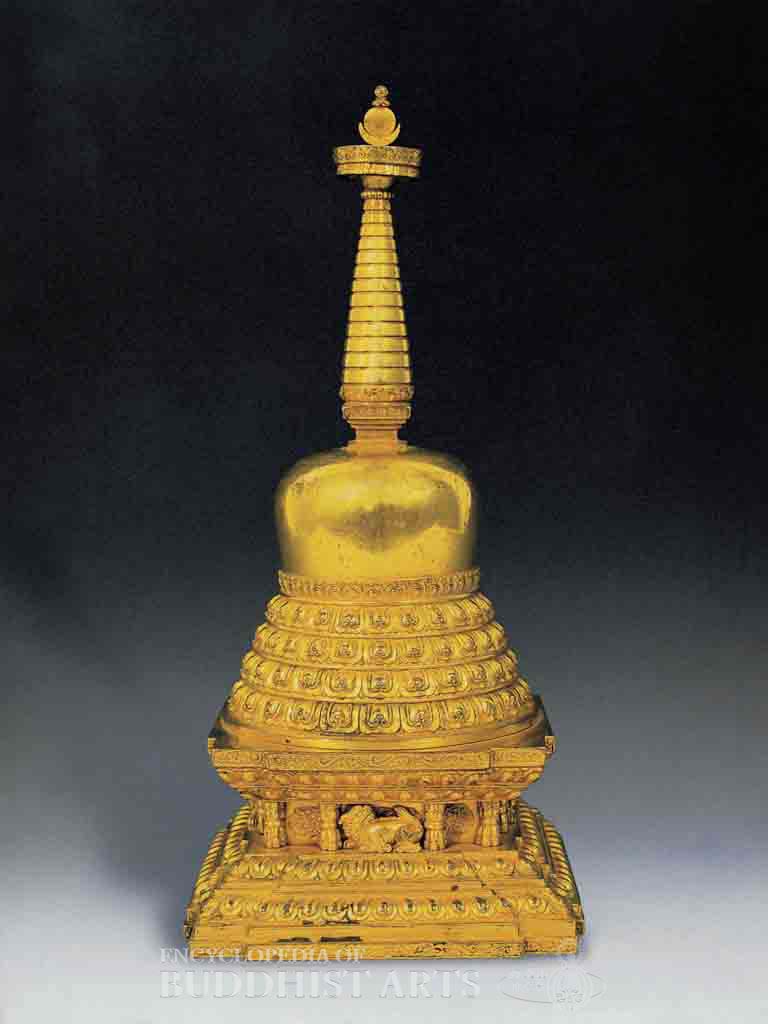
This stupa, also known as the Lotus Blossom Stupa, epicts the Birth of Prince Siddhartha. It is one of the eight types of Tibetan stupas which represent different stages of the Life of the Buddha.
The stupa consists of a base, body, and spire. The Sumeru-shaped base has two layers of lotus petals on the upper and lower parts. The sides of the concave section have four pilasters with a crouching lion in the center, and Buddhist scenes on either side.
Four layers of inverted lotus petals followed by a ring of upright lotus petals decorate the lower part of the body. The upper body consists of an inverted bowl, and the harmika has an inscription reading, “Emperor Yongle (reigned 1402–1424) of the Ming dynasty.” The spire consists of an upright lotus, 13 stacked rings, a canopy, and a finial which is composed of a horizontal crescent moon, sun, and jewel.
For more details, go to the Encyclopedia of Buddhist Arts: Artifacts, page 315.
Cite this article:
author = Hsingyun and Youheng and Youji and Pokorski, Stefanie and Mankuang and Fan, Wen,
booktitle = {Encyclopedia of Buddhist Arts: Artifacts },
pages = 315,
title = {{Stupa}},
volume = 18,
year = {2016}}