
Trumpet
Copper
Trumpet
CHINA; Qing dynasty
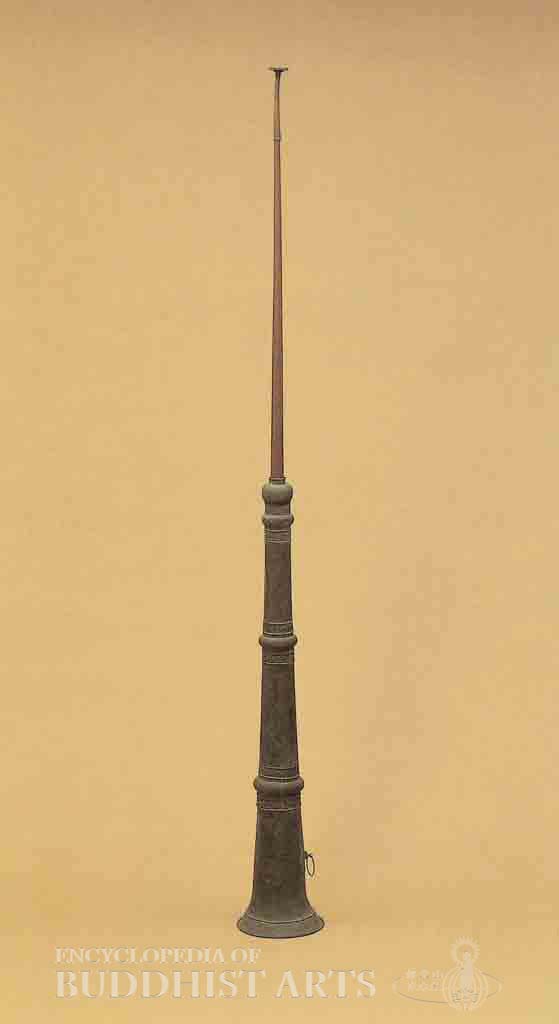
This type of trumpet, known as “rag dun” in Tibetan, is an instrument used in Vajrayana Buddhism during Buddhist festivals and Dharma functions.
The trumpet consists of three sections which fit inside one another and can be extended up to 5 m. It is the longest of Tibetan wind instruments and produces the strongest sound. It is placed on either a wooden stand or a person’s shoulders.
According to records, trumpets were first used during oath ceremonies during the Tibetan period (circa 7th–9th century), and were later regularly played as Buddhist Dharma instruments.
For more details, go to the Encyclopedia of Buddhist Arts: Artifacts, page 354.
Cite this article:
Hsingyun, et al. "Trumpet." Encyclopedia of Buddhist Arts: Artifacts , vol. 18, 2016, pp. 354.
Hsingyun, Youheng, Youji, Stefanie Pokorski, Mankuang, and Wen Fan. 2016. "Trumpet" In Encyclopedia of Buddhist Arts: Artifacts , 18:354.
Hsingyun, Youheng, Youji, Pokorski, S., Mankuang, & Fan, W.. (2016). Trumpet. In Encyclopedia of Buddhist Arts: Artifacts (Vol. 18, pp. 354).
@misc{Hsingyun2016,
author = Hsingyun and Youheng and Youji and Pokorski, Stefanie and Mankuang and Fan, Wen,
booktitle = {Encyclopedia of Buddhist Arts: Artifacts },
pages = 354,
title = {{Trumpet}},
volume = 18,
year = {2016}}
author = Hsingyun and Youheng and Youji and Pokorski, Stefanie and Mankuang and Fan, Wen,
booktitle = {Encyclopedia of Buddhist Arts: Artifacts },
pages = 354,
title = {{Trumpet}},
volume = 18,
year = {2016}}