
Qing Imperial Palace: Prayer Beads
Bone
Qing Imperial Palace: Prayer Beads
CHINA, Beijing; Qing dynasty
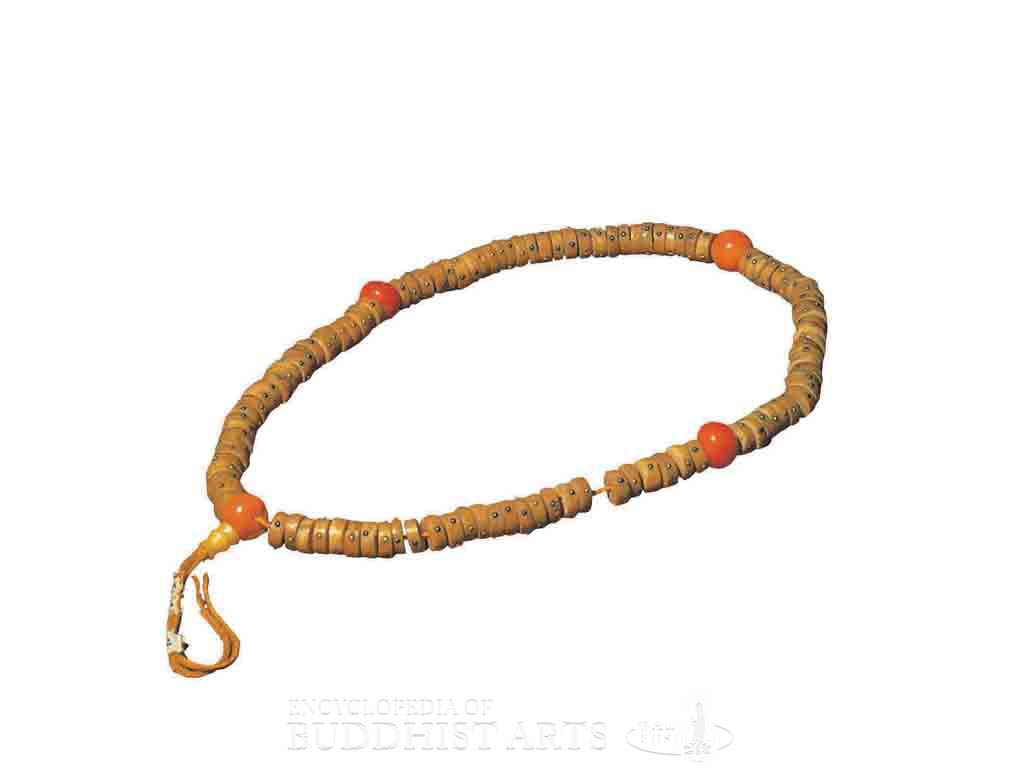
Made from human bone, this string of Tibetan prayer beads used by the imperial family was created during the Qing dynasty and has been restored. It was kept in the collection of the Qing Imperial Palace.
A yellow thread was used to string 108 pieces of bone to form these prayer beads. Each bead is cylindrical in shape and has the same thickness. There are four larger spacer beads inserted between each 27 beads, dividing it into four sections. There are raised dots on the beads to make them easier to manipulate and count. The yellow thread extends from the guru bead, where there is a colored image of the Buddha.
For more details, go to the Encyclopedia of Buddhist Arts: Artifacts, page 256.
Cite this article:
Hsingyun, et al. "Qing Imperial Palace: Prayer Beads." Encyclopedia of Buddhist Arts: Artifacts , vol. 18, 2016, pp. 256.
Hsingyun, Youheng, Youji, Stefanie Pokorski, Mankuang, and Wen Fan. 2016. "Qing Imperial Palace: Prayer Beads" In Encyclopedia of Buddhist Arts: Artifacts , 18:256.
Hsingyun, Youheng, Youji, Pokorski, S., Mankuang, & Fan, W.. (2016). Qing Imperial Palace: Prayer Beads. In Encyclopedia of Buddhist Arts: Artifacts (Vol. 18, pp. 256).
@misc{Hsingyun2016,
author = Hsingyun and Youheng and Youji and Pokorski, Stefanie and Mankuang and Fan, Wen,
booktitle = {Encyclopedia of Buddhist Arts: Artifacts },
pages = 256,
title = {{Qing Imperial Palace: Prayer Beads}},
volume = 18,
year = {2016}}
author = Hsingyun and Youheng and Youji and Pokorski, Stefanie and Mankuang and Fan, Wen,
booktitle = {Encyclopedia of Buddhist Arts: Artifacts },
pages = 256,
title = {{Qing Imperial Palace: Prayer Beads}},
volume = 18,
year = {2016}}