
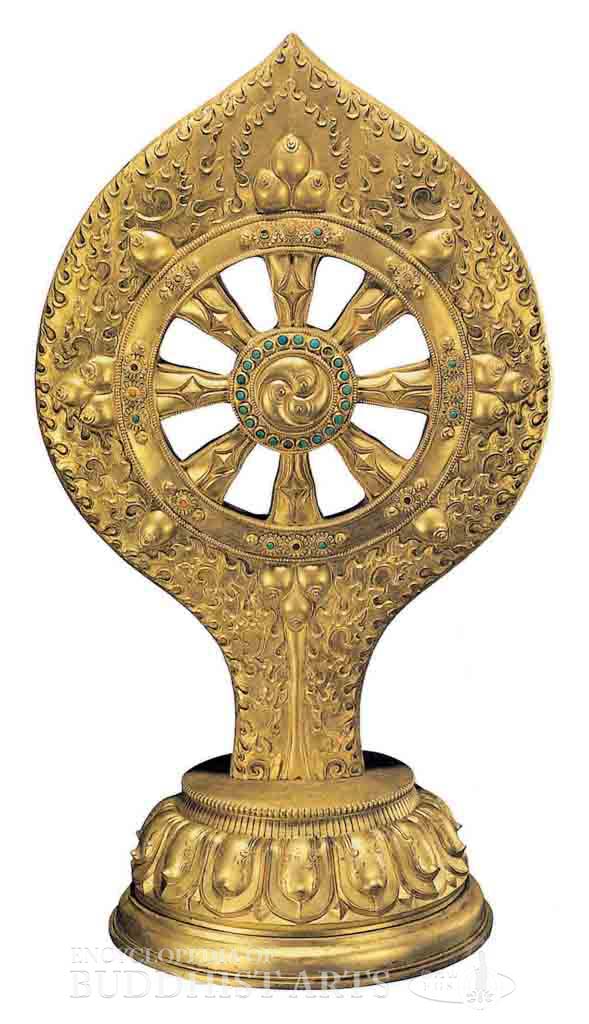
Qing Imperial Palace: Dharma Wheel
Gilt copper alloy
Qing Imperial Palace: Dharma Wheel
CHINA, Beijing; Qing dynasty
Representing the teaching of the Buddha, the Dharma wheel is widely-used Buddhist art. And as one of the eight auspicious symbols, it is commonly used in Tibetan Buddhist instruments. This Dharma wheel was created in the imperial palace during the Qing dynasty. It is made of gilt copper alloy and measures 41 cm high.
Stands on a round lotus base, the Dharma wheel is in the shape of a lotus petal with the wheel at the center. The hub is in the form of a mani symbol surrounded by turquoise beads and is connected to the rim by eight thick spokes. The rim is decorated with a series of red, black, and turquoise beads. The area outside the wheel is filled with flame and jewel motifs.
For more details, go to the Encyclopedia of Buddhist Arts: Artifacts, page 249.
Cite this article:
author = Hsingyun and Youheng and Youji and Pokorski, Stefanie and Mankuang and Fan, Wen,
booktitle = {Encyclopedia of Buddhist Arts: Artifacts },
pages = 249,
title = {{Qing Imperial Palace: Dharma Wheel}},
volume = 18,
year = {2016}}