
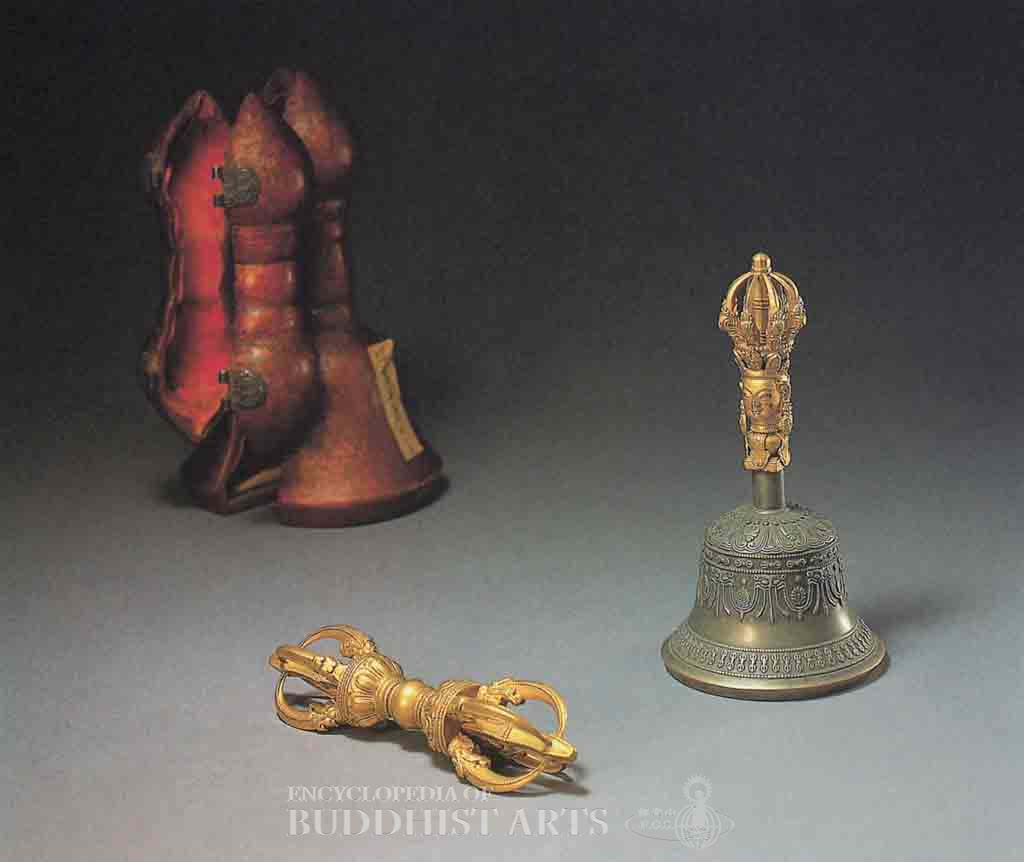
Vajra and Bell
Copper alloy
Vajra and Bell
CHINA; Ming dynasty
Created during the rule of Emperor Yongle (reigned 1402–1424) of the Ming dynasty, this vajra and bell were a gift from the emperor to an eminent Tibetan monk and are kept in a red case.
The vajra is made of gilt copper alloy and has five prongs, with the outer ones emerging from the mouths of makaras. On either end of the handle, there is a ring of lotus petals and bead patterns.
The bell is made of copper alloy with a gilt handle, the top of which is in the form of a seven-prong vajra. The outer prongs emerge from the mouths of makaras, and the bottom of the handle features the head of a Buddha wearing a crown. The shoulder of the bell is decorated with lotus petals containing the Six-Syllables Mantra. There is a ring of horizontal vajras decorating the upper waist of the bell followed by designs with taotie, a mythical creature. Towards the rim of the bell, there is a row of vertical vajras with a bead border.
For more details, go to the Encyclopedia of Buddhist Arts: Artifacts, page 358.
Cite this article:
author = Hsingyun and Youheng and Youji and Pokorski, Stefanie and Mankuang and Fan, Wen,
booktitle = {Encyclopedia of Buddhist Arts: Artifacts },
pages = 358,
title = {{Vajra and Bell}},
volume = 18,
year = {2016}}