
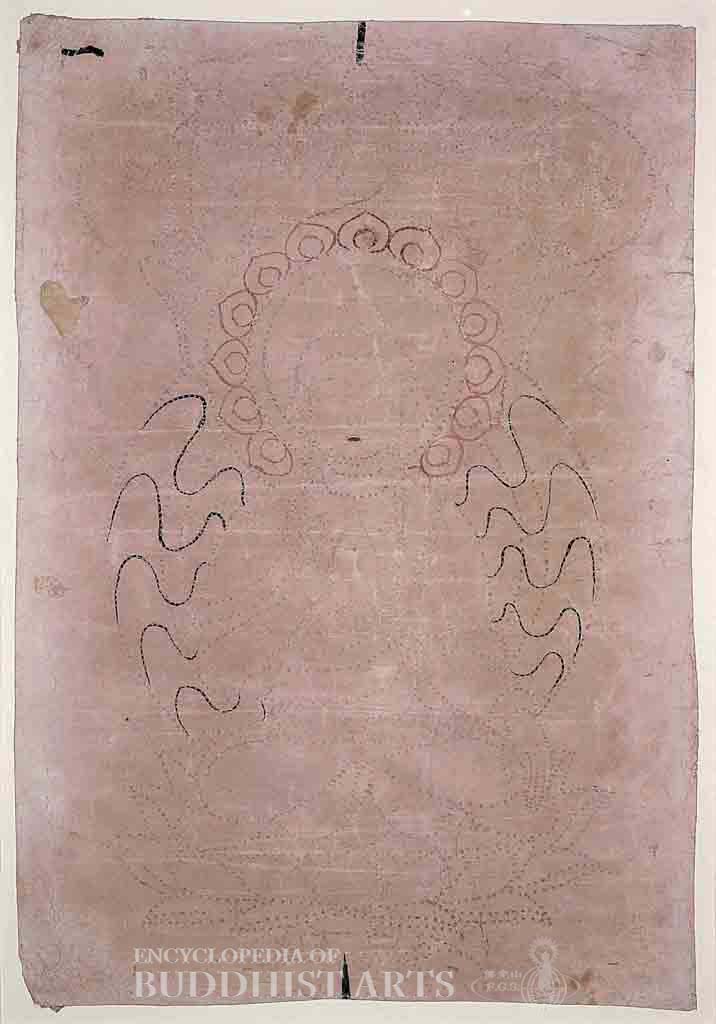
Mogao Cave 17: Seated Buddha
paper
Mogao Cave 17: Seated Buddha
CHINA, Gansu, Dunhuang; Five Dynasties to Northern Song dynasty
This 10th century object from Mogao Cave 17 was meant to be used as a stencil for creating murals. The faint figure of the Buddha sits on a lotus throne with hands in the vitarka (teaching) mudra. Small pinholes are used to form the image. Thus, it could be placed against a wall and coated with chalk, creating an outline for mural artists to fill in. Black wavy lines are used to depict radiating light from the aureole, while red is applied to the lips and edges of the nimbus. The three dark lines on the edge may have been used as aligning markers.
For more details, go to the Encyclopedia of Buddhist Arts: Painting I-O, page 653.
Cite this article:
Hsingyun, et al. "Mogao Cave 17: Seated Buddha." Encyclopedia of Buddhist Arts: Painting I-O, vol. 15, 2016, pp. 653.
Hsingyun, Youheng, Youlu, Graham Wilson, Manho, Mankuang, and Susan Huntington. 2016. "Mogao Cave 17: Seated Buddha" In Encyclopedia of Buddhist Arts: Painting I-O, 15:653.
Hsingyun, Youheng, Youlu, Wilson, G., Manho, Mankuang, & Huntington, S.. (2016). Mogao Cave 17: Seated Buddha. In Encyclopedia of Buddhist Arts: Painting I-O (Vol. 15, pp. 653).
@misc{Hsingyun2016,
author = Hsingyun and Youheng and Youlu and Wilson, Graham and Manho and Mankuang and Huntington, Susan,
booktitle = {Encyclopedia of Buddhist Arts: Painting I-O},
pages = 653,
title = {{Mogao Cave 17: Seated Buddha}},
volume = 15,
year = {2016}}
author = Hsingyun and Youheng and Youlu and Wilson, Graham and Manho and Mankuang and Huntington, Susan,
booktitle = {Encyclopedia of Buddhist Arts: Painting I-O},
pages = 653,
title = {{Mogao Cave 17: Seated Buddha}},
volume = 15,
year = {2016}}