

Mogao Cave 17: Illustration of the Sutra on the Ten Kings of Hell (detail)
Ink and color on paper
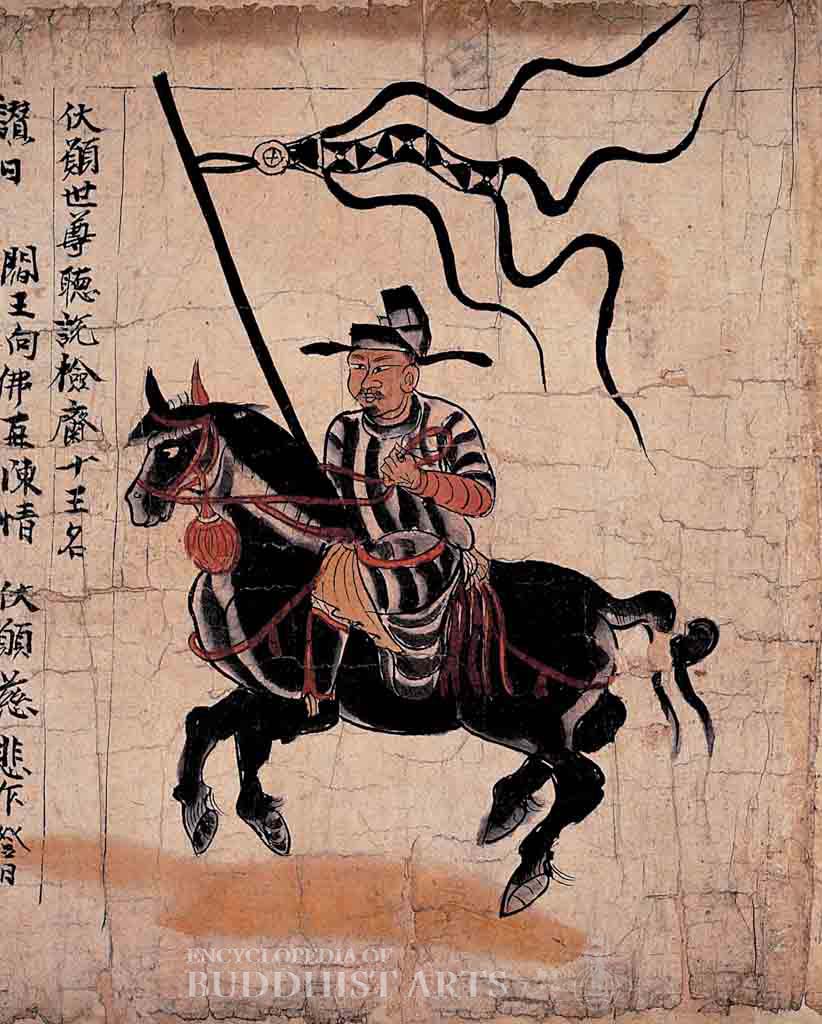
Mogao Cave 17: Illustration of the Sutra on the Ten Kings of Hell (detail)
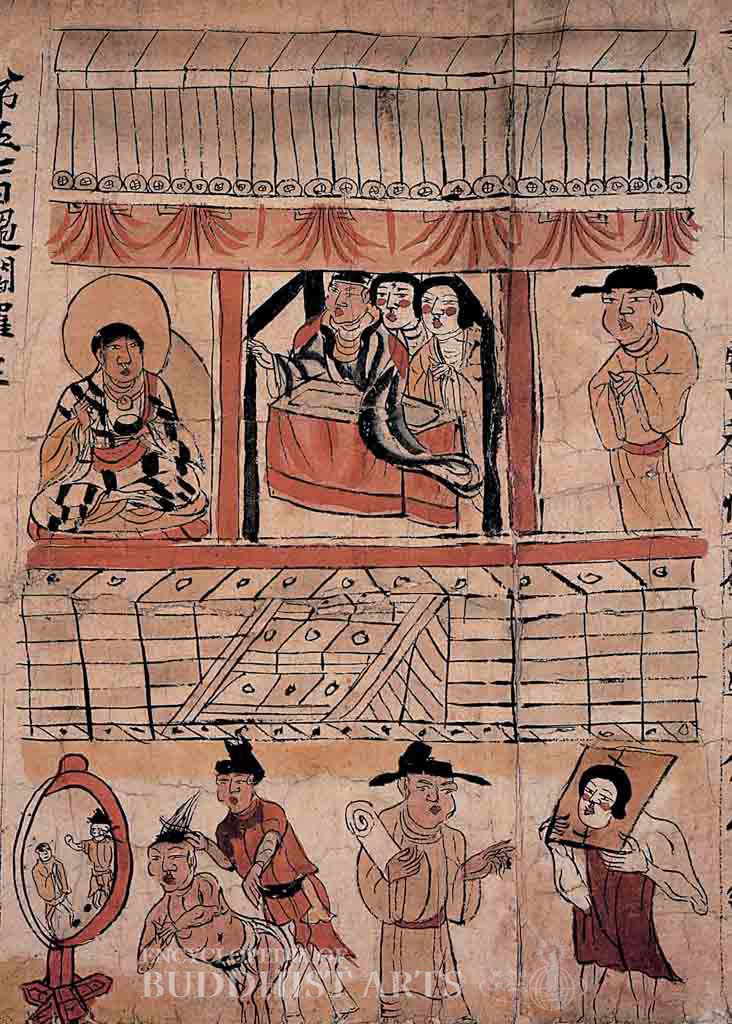
Mogao Cave 17: Illustration of the Sutra on the Ten Kings of Hell (detail)
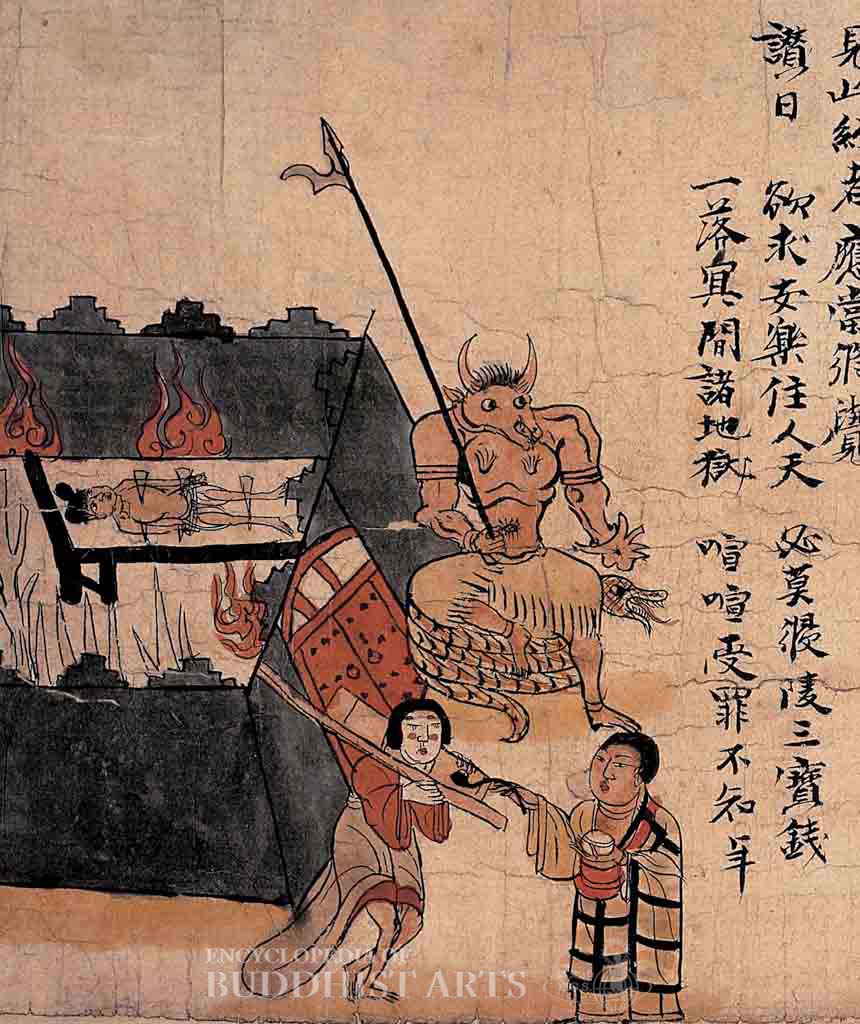
Mogao Cave 17: Illustration of the Sutra on the Ten Kings of Hell (detail)
Mogao Cave 17: Illustration of the Sutra on the Ten Kings of Hell
CHINA, Gansu, Dunhuang; Northern Song dynasty
This mid to late 10th century painting illustrates scenes from the Sutra on the Ten Kings of Hell. A messenger from hell, dressed in black and carrying a black flag, rides on a black horse from the far right side of the painting towards the left, implying that the scenes are narrated in this direction. Ten scenes of the judgment of the dead by the ten kings are shown. These judgments occur at intervals of seven days starting from the seventh day after death and continuing to the 49th day; subsequently there are judgments on the 100th day as well as after the first and second year following death.
The Ten Kings sit behind tables and are surrounded by attendants. The dead souls undergoing judgment are restrained in cangues, large wooden boards that trap the neck. Judgment on the 35th day is presided over by the Fifth King of Hell, King Yama, who is seated within a pavilion. An official drags the dead soul by his hair, bringing him to look into the karmic mirror, which reflects his actions in life. In the illustration of the Tenth King of Hell, images of the beings in the six realms of rebirth are painted between red lines.
The layout of the texts suggests they were likely written after the painting was completed. Though the style is somewhat simplistic, the images vividly portray the karmic consequences that await wrongdoers after death, discouraging people from doing evil.
For more details, go to the Encyclopedia of Buddhist Arts: Painting I-O, page 608.
Cite this article:
author = Hsingyun and Youheng and Youlu and Wilson, Graham and Manho and Mankuang and Huntington, Susan,
booktitle = {Encyclopedia of Buddhist Arts: Painting I-O},
pages = 608,
title = {{Mogao Cave 17: Illustration of the Sutra on the Ten Kings of Hell}},
volume = 15,
year = {2016}}