
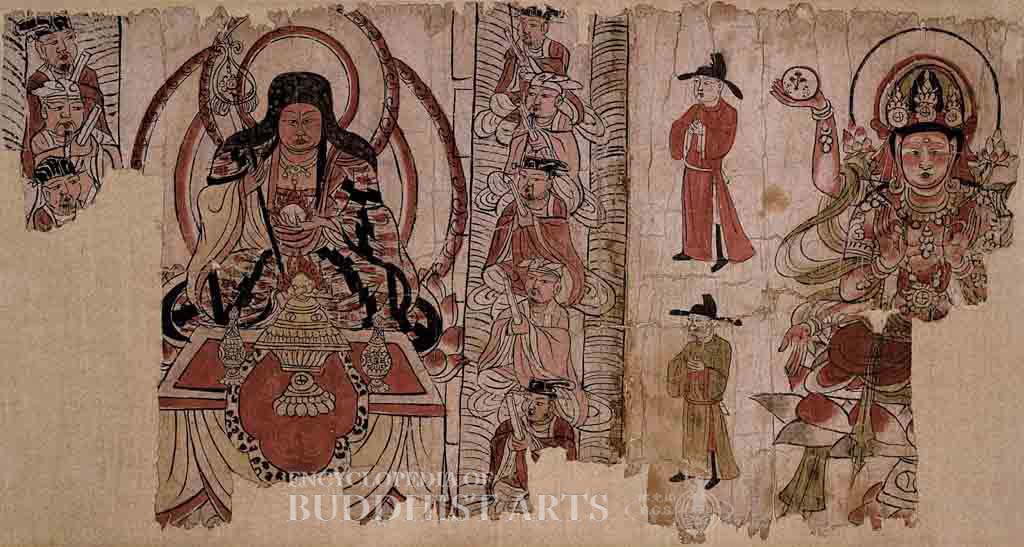
Mogao Cave 17: Frontispiece of the Sutra on the Ten Kings of Hell
Ink and color on paper
Mogao Cave 17: Frontispiece of the Sutra on the Ten Kings of Hell
CHINA, Gansu, Dunhuang; Five Dynasties
On this frontispiece of the Sutra on the Ten Kings of Hell, Six-Armed Avalokitesvara Bodhisattva is on the right, and Ksitigarbha Bodhisattva and the Ten Kings of Hell are on the left. Part of Avalokitesvara’s body is obscured by damage. The Bodhisattva sits on a lotus throne, wearing a trefoil crown and ornaments. The raised hands supports a sun disc, which is no longer visible, and a moon disc containing an image of a rabbit beneath a tree. Two figures wearing black hats stand on the left, facing away from Avalokitesvara.
Ksitigarbha sits on a lotus throne behind an altar. Surrounded by a large nimbus and aureole, the Bodhisattva wears a headscarf and a patterned monastic robe. The left hand cradles a flaming wish-fulfilling jewel in front of the chest, and the right hand grasps a monk’s staff. An incense burner rests on the altar below Ksitigarbha. The Ten Kings of Hell are arranged in two rows on either side of the Bodhisattva. Part of the row on the left has torn away, leaving only three figures visible. The Kings have thin beards and hold imperial court batons. Thin black lines are painted behind them.
According to the Sutra on the Ten Kings of Hell, one who upholds the names of the respective Buddhas and Bodhisattvas corresponding to the ten days of practice would be able to eradicate misfortunes and accumulate merits. The ten days of practice refer to the 1st, 8th, 14th, 15th, 18th, 23rd, 24th, and the last three days of the lunar calendar. The names of the Buddhas and Bodhisattvas corresponding to these days are respectively Dipamkara Buddha, Medicine Buddha, Thousand Buddhas of the Present Kalpa, Amitabha Buddha, Ksitigarbha Bodhisattva, Mahasthamaprapta Bodhisattva, Avalokitesvara Bodhisattva, Vairocana Buddha, Bhaisajyaraja Bodhisattva, and Sakyamuni Buddha.
It was also recorded in the sutra that after one’s death, one will undergo interrogation by the Ten Kings of Hell on the deeds carried out in the previous lifetime. Among the ten kings, the eighth king is a manifestation of Avalokitesvara Bodhisattva known as the King of Equality. He is responsible for the fair judgment of the deceased according to the virtuous actions or misdeeds committed.
For more details, go to the Encyclopedia of Buddhist Arts: Painting I-O, page 590.
Cite this article:
author = Hsingyun and Youheng and Youlu and Wilson, Graham and Manho and Mankuang and Huntington, Susan,
booktitle = {Encyclopedia of Buddhist Arts: Painting I-O},
pages = 590,
title = {{Mogao Cave 17: Frontispiece of the Sutra on the Ten Kings of Hell}},
volume = 15,
year = {2016}}