
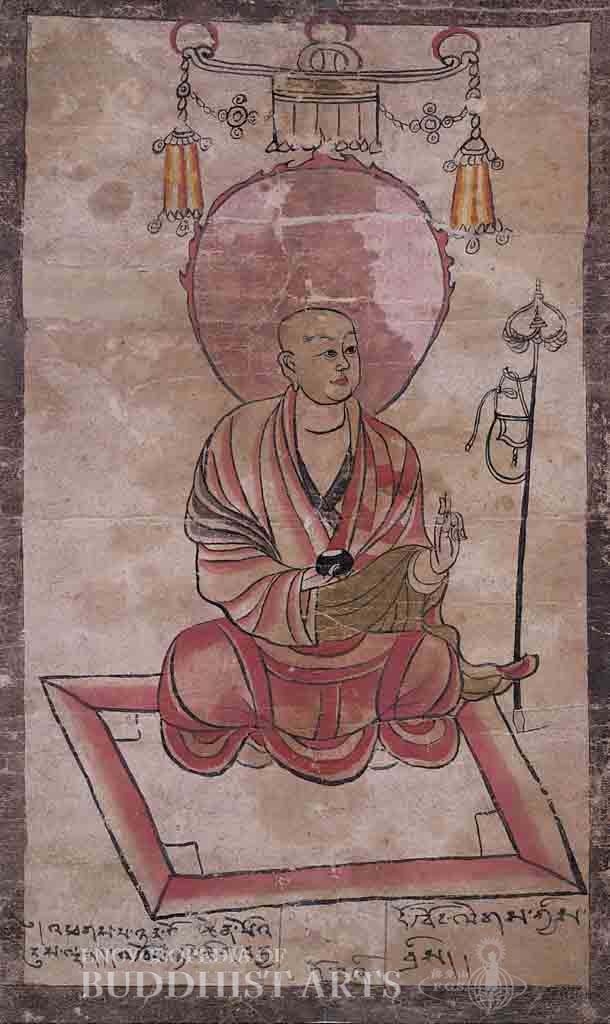
Mogao Cave 17: Kalika
Ink and color on paper
Mogao Cave 17: Kalika
CHINA, Gansu, Dunhuang; Tang dynasty
The inscription in Tibetan at the bottom of this early 9th century work identifies the central figure as Kalika, one of the Sixteen Arhats, the great early disciples of the Buddha. Depicted as a Chinese monk sitting on a mat in full lotus position, Kalika looks calm and focused. He wears a robe, forms a mudra with his left hand, and holds a bowl in his right. The red nimbus is outlined with flame patterns. A canopy is painted at the top of the picture. On the right, a pouch hangs from a hook on a monk’s staff.
For more details, go to the Encyclopedia of Buddhist Arts: Painting I-O, page 610.
Cite this article:
Hsingyun, et al. "Mogao Cave 17: Kalika." Encyclopedia of Buddhist Arts: Painting I-O, vol. 15, 2016, pp. 610.
Hsingyun, Youheng, Youlu, Graham Wilson, Manho, Mankuang, and Susan Huntington. 2016. "Mogao Cave 17: Kalika" In Encyclopedia of Buddhist Arts: Painting I-O, 15:610.
Hsingyun, Youheng, Youlu, Wilson, G., Manho, Mankuang, & Huntington, S.. (2016). Mogao Cave 17: Kalika. In Encyclopedia of Buddhist Arts: Painting I-O (Vol. 15, pp. 610).
@misc{Hsingyun2016,
author = Hsingyun and Youheng and Youlu and Wilson, Graham and Manho and Mankuang and Huntington, Susan,
booktitle = {Encyclopedia of Buddhist Arts: Painting I-O},
pages = 610,
title = {{Mogao Cave 17: Kalika}},
volume = 15,
year = {2016}}
author = Hsingyun and Youheng and Youlu and Wilson, Graham and Manho and Mankuang and Huntington, Susan,
booktitle = {Encyclopedia of Buddhist Arts: Painting I-O},
pages = 610,
title = {{Mogao Cave 17: Kalika}},
volume = 15,
year = {2016}}