
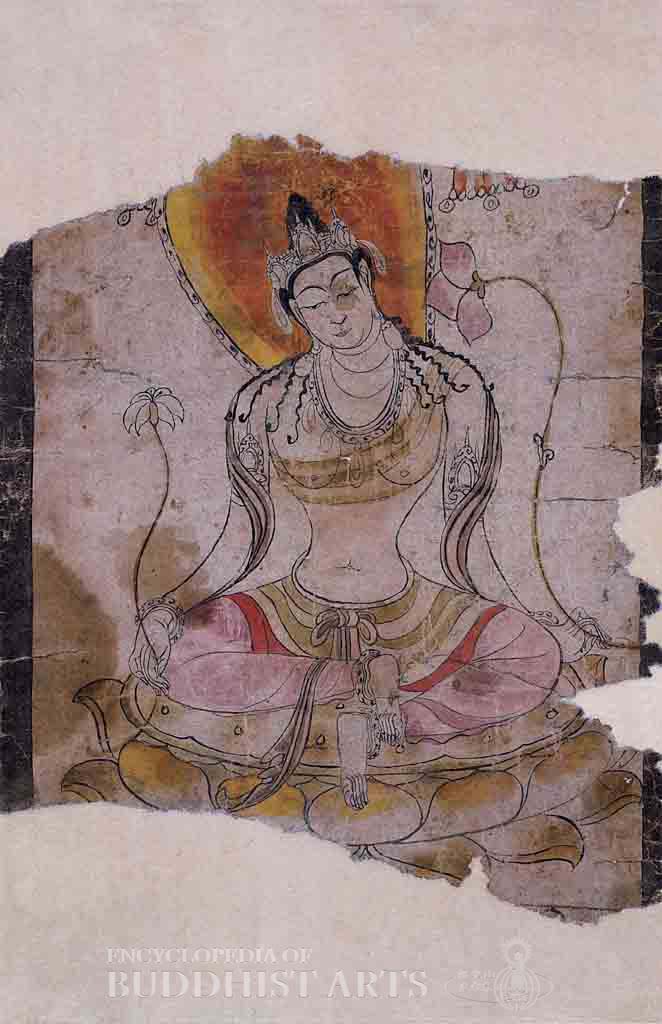
Mogao Cave 17: Seated Bodhisattva
Ink and color on paper
Mogao Cave 17: Seated Bodhisattva
CHINA, Gansu, Dunhuang; Tang dynasty
This painting from the early 9th century features a seated Bodhisattva wearing a headdress over curled hair that hangs down past the shoulders. The nimbus is colored in a blend of orange and yellow and is outlined with spiral patterns. The Bodhisattva has pursed lips and downcast eyes. Wide shoulders taper down to a slim waist, giving the figure a unique appearance. Faintly drawn jewelry adorns the body. A transparent stole is tightly wound around the arms and across the chest. The Bodhisattva sits on a lotus throne, holding the stem of a flower in each hand.
The painting is similar in style to two other artworks, one portraying Kalika and the other depicting Sakyamuni Buddha, that were discovered in Cave 17 and are now kept in the British Museum. These three paintings all have brown borders, and the central figures have similarly colored nimbuses. Although the text at the bottom of this picture is missing, the other two images have inscriptions written in ancient Tibetan.
For more details, go to the Encyclopedia of Buddhist Arts: Painting I-O, page 651.
Cite this article:
author = Hsingyun and Youheng and Youlu and Wilson, Graham and Manho and Mankuang and Huntington, Susan,
booktitle = {Encyclopedia of Buddhist Arts: Painting I-O},
pages = 651,
title = {{Mogao Cave 17: Seated Bodhisattva}},
volume = 15,
year = {2016}}