
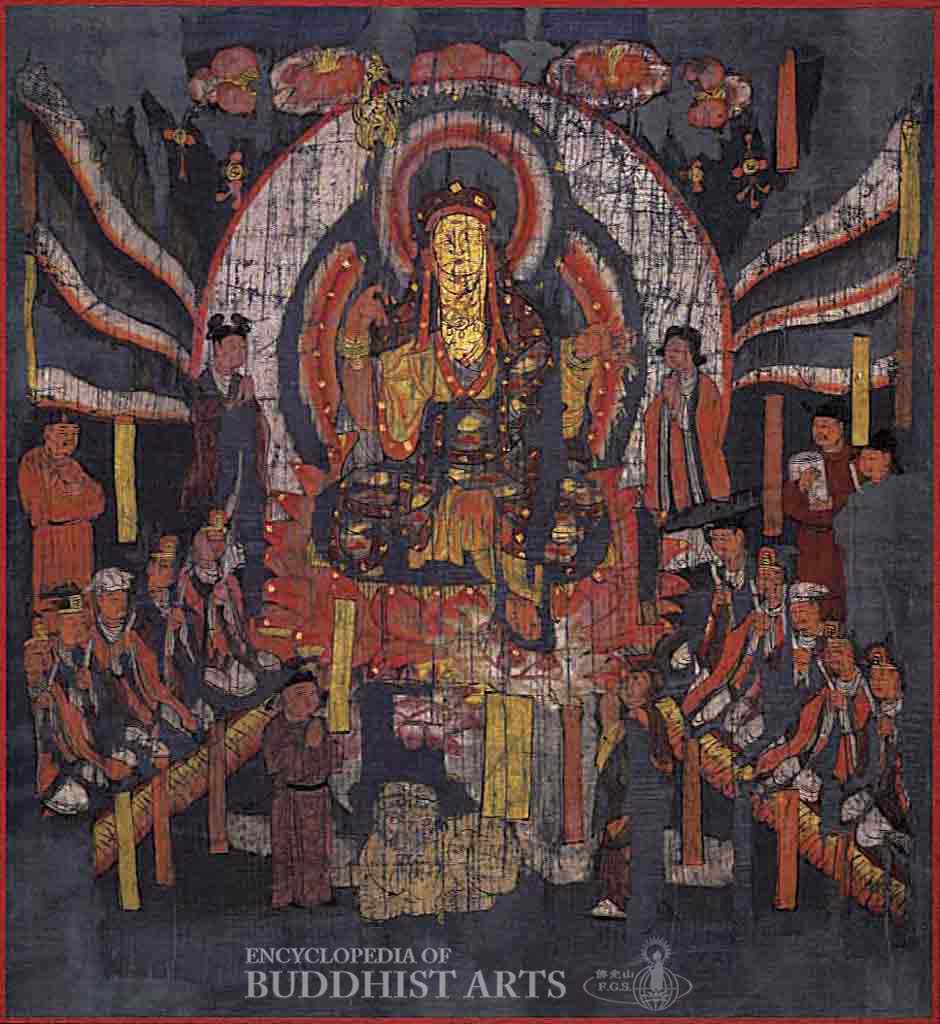
Mogao Cave 17: Ksitigarbha Bodhisattva and the Ten Kings of Hell
Ink and color on silk
Mogao Cave 17: Ksitigarbha Bodhisattva and the Ten Kings of Hell
CHINA, Gansu, Dunhuang; Five Dynasties
According to the Sutra on the Ten Kings of Hell, all beings must go to hell to undergo judgment by the ten kings after death. The sutra mentions the resolution of Ksitigarbha Bodhisattva to forego enlightenment until all of the hells are empty, and ends by stating “All phenomena are impermanent, and abide by the law of birth and death. When the concepts of birth and death are surpassed, one attains the joy of nirvana.”
In the painting, Ksitigarbha has gold skin and wears a headscarf. The nimbus, clothing, and lotus throne are decorated with diamond-shaped gold leaf designs. Six rays of curving light emanate from the mandorla, representing the six realms of existence. The Bodhisattva is flanked by the Recorders of Good and Evil.
In front of the lotus throne is the monk Daoming, a golden lion, and a deceased being seeking help. The Ten Kings of Hell sit in angled rows below the lotus throne, each holding a scepter. Seated on the right side nearest to Ksitigarbha is King Yama, wearing a crown and accompanied by officials holding a pen and a record book behind him.
For more details, go to the Encyclopedia of Buddhist Arts: Painting I-O, page 617.
Cite this article:
author = Hsingyun and Youheng and Youlu and Wilson, Graham and Manho and Mankuang and Huntington, Susan,
booktitle = {Encyclopedia of Buddhist Arts: Painting I-O},
pages = 617,
title = {{Mogao Cave 17: Ksitigarbha Bodhisattva and the Ten Kings of Hell}},
volume = 15,
year = {2016}}