
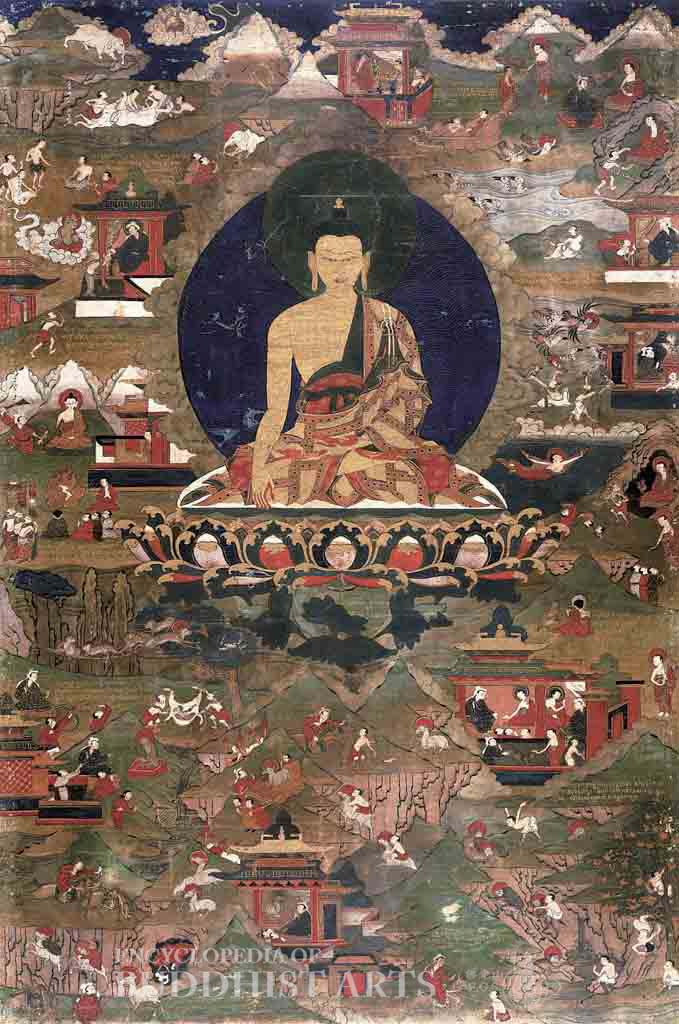
Illustrations of Jataka Tales
Ink and color on cotton

Illustrations of Jataka Tales (detail)
Illustrations of Jataka Tales
CHINA; Ming dynasty
Tibetan inscriptions on this painting imply that it is the third in a series of paintings. It depicts stories 21 through 30 of the former lives of the Buddha described in the Jatakamala, a Sanskrit text by Aryasura. Sakyamuni Buddha is in the center of the painting, wearing a monastic robe draped over the left shoulder. Seated in full lotus position on a lotus throne, he forms the bhumisparsa (earth-touching) mudra. The Buddha has a dark green nimbus and a large blue aureole decorated with thin gold lines and surrounded by billowing dark clouds.
Around the Buddha, there are small, detailed depictions of the ten Jataka tales. Expressing themes of compassion and self-sacrifice, the stories, moving clockwise from the upper right corner, are as follows: Culla Bodhi Jataka, Hamsa Jataka, Mahabodhi Jataka, Kapi Jataka, Sarabha Jataka, Ruru Jataka, Mahakapi Jataka, Ksantivadi Jataka, Jataka of Brahma and King Angadinna, and Hasti Jataka.
The stories are arranged within a landscape of mountains, lakes, rocks, and trees, characteristic of Ming dynasty paintings. Predominantly white or red, the figures seem to move about amid the green and brown color washes of the landscape. Palaces colored in red and dark green are depicted among triangular hills, snow-capped peaks, and weathered rocks. In each scene, the Buddha, whether animal or human, can be identified by his red nimbus. The dynamically posed figures are portrayed with a charming simplicity and verve, typical of paintings from eastern Tibet. The central figure, for example, has broad shoulders and a slim waist. This athletic, youthful image of the Buddha is in sharp contrast to the more gentle and sedate ideal found in images from western Tibet. The artist was likely trained in both Tibetan and Chinese painting skills.
For more details, go to the Encyclopedia of Buddhist Arts: Painting I-O, page 379.
Cite this article:
author = Hsingyun and Youheng and Youlu and Wilson, Graham and Manho and Mankuang and Huntington, Susan,
booktitle = {Encyclopedia of Buddhist Arts: Painting I-O},
pages = 379,
title = {{Illustrations of Jataka Tales}},
volume = 15,
year = {2016}}